Monday, 29 February 2016

Polaris


Mythos and History
Jenarong-Era depiction of Polaris

    During the reign of Yelm, the sky world was harmonious. Dayzatar, the brother of Yelm stood in the centre of the sky in peaceful meditation, and the sky people stood surrounding him, perfect and unmoving.
    Things turned wrong when the Disruptor came. A flaw had appeared in the sky, a dark hole, through which entered Umatum. He would not be still, and he would not be harmonious. He moved about the sky, causing destruction and disorder, until all the sky people were moving in his wake, unsure where to go.
    The sky people went to beg Dayzatar for his aid. He would have remained unmoved, for it was not his place to deal with the impure; but seeing the disruption caused by Umatum, he felt sorrow and anger.
    He took these feelings, and removed them from himself, creating Polaris, the pure fire. Satisfied, he returned to his meditations.
    Polaris, born fully formed, showed the sky people how to oppose Umatum, and drive him down below. With the Disruptor vanquished, the sky people tried to relax, but found they could not stand still. Umatum had used the last of his strength to wrench the sky world, and send it spinning. The sky people did not know where to stand, and were terrified.
    Having once been part of Dayzatar, Polaris knew where the Pillar God stood, and stood above him. He gave a mighty cry, and drew the attention of the sky people.
    As they all stood staring at him, he directed them to their places in the sky, and though they still moved with the turning of the world, they were still in the right places. In this way, Polaris restored harmony to the sky world. Polaris became a hero of the sky people, and married well, fathering many children.
    When Yelm was killed, many things went wrong. The Pillar God crumbled and burned, before turning into ash. This left a hole in the centre of the sky, beneath Polaris. Any lesser being would have fallen from sorrow at seeing the world below all at once, but Polaris had Dayzatar's mind, and was able to withstand the vision. He took some Steadfast, and built it into a wall around the hole. So perfect was his speed, that he could do this before any others approached the hole. When they came, and asked to see what was beyond the wall, Polaris refused.
    At first, many relented, and went back to their proper positions. But a few had too much curiosity, and kept begging Polaris. Polaris took those who remained, and made them swore sacred oaths to follow his every word, and never to repeat what they saw to others.
    So armed, these sky people looked down, and saw the world where Yelm had died, full of impurity and pain. Their hearts ached, but their oaths held, and they did not fall with sorrow.
    While Polaris was taking the oaths of the sky people; his son, the young god Lightfore, looked into the hole. He had not been sanctified by oaths, nor was he as great as his father. He could not stand the sight of the world, and left the cosmos in panic. Polaris mourned his loss, but would not relent in his duty, staying in the centre of the sky, to create harmony. When other holes were created in the sky world, Polaris picked a guard from the ranks of those who had sworn oaths to him. They would go to the hole and erect a wall, creating a small fortress to protect the sky against corruption. They became Polaris' followers, the Star Captains.
    Without Yelm, the gods of water were free to act wrongly once again. They raged against the land, but most of all, they hated the purity of the skies. One of them, the serpent Lorion, desired to taste the purity of Dayzatar himself, to corrupt him with its wetness; and would risk anything to accomplish this. It rose into the sky, bearing within itself, the other gods of water. The foulness in the heavens was so terrible that Dayzatar ceased his meditations. The pure god refused to be tainted by the serpent, even when it threatened to drown the sky world. Dayzatar knew only one thing could be done, he would need to seek out the child Lightfore, and would travel outside of the world and sky to do so.
    When the people of the sky heard this, they wept, for without Dayzatar, the serpent would devour them all. They begged Dayzatar to stay, or to allow them to follow him, but he could not. Instead, Dayzatar gave Polaris a crown and staff, and named him the General of Heaven, who all others must obey. Polaris' great leadership had saved the sky people before, and they were comforted and listened to him.
    Polaris instructed all of the sky people to retreat to the centre of heaven, and to make a great circle of steadfast to surround them all. He called this the Firmament, and when Lorion tried to devour the sky people, he found himself unable to even scratch it, and was diverted to form the celestial river.
    The Firmament was full of all the gods of light, and shone so brightly that the people of the world below could see it now that Yelm was gone. They called it the Celestial City, and tried to emulate it. Polaris felt pity upon them, and so he took part of his Purity, enough that he stumbled for a second, and turned it into a shield. He gave the shield to one of his Star Captains, who took it down to the most worthy man in the corrupt world.
    This was Urvairinus, he was one of Yelm's descendants, and was born on his father's chariot. War was his birthright, and sorrow his mother. He alone was noble enough to carry the Shield of Purity, but terrible enough to do what must be done. When he took the shield, he learned of Polaris, and how he had saved the sky world, and announced that he would do the same upon the earth.
He gathered up a hundred men, gave them the tools of war made by the crafters, and taught them of Polaris, he showed them how to stand, mirroring the Celestial City, with each man guarding his neighbour, and facing the four directions. He named this the Sunstand Formation, and it became the first of the arts of Polaris to be taught to man.
    When the barbarians came to attack Urvairinus, he took his hundred men to oppose them. The barbarians could find no weakness, no flaw in the Sunstand, and though they raged and wept, could not injure a single soldier. Urvairinus was glad, for Polaris had taught him how to protect his people, and he named Polaris the War God, and decreed all soldiers should worship him.
    With the devotion of many, Polaris was able to safeguard the sky world for many centuries, as well as the world beneath, through his followers, the mortal armies, and the Star Captains. And so it was until Dayzatar returned, atop the sky dome where only Polaris could see him. He spoke to his child, telling him of Lightfore, who had truly not gone mad, or been driven by fear, but only left because of what he had seen, the portion of Yelm, descending into the lands of the dead. Lightfore had gone after it, and had now succeeded in aiding Yelm, allowing the god to reascend.
    Lightfore returned to his father, mounted upon a magnificent steed, to proclaim the return of Yelm, and all the sky and earth rejoiced.


Nature of the Cult
Polaris is the Star Lord, General of Heaven, Keeper of the Sky Dance, and Post Top. He is the still centre of the sky, around which the heavens turn. He is patron of dancers, musicians, and, perhaps most importantly, the Dara Happan army.
After death, his worshippers know that they will be reborn in the sky world as motes of light. The most powerful of his followers will become Certami, the warrior gods of Heaven.


Depiction
Polaris is most commonly depicted as a Dara Happan warrior, standing upright, and garbed for battle. On his head rests a crown of tin, while his left hand holds a spear, around which is tightly wrapped a banner.
Plentonious believed that Polaris was the twenty-third figure on the first row on the Gods Wall, based on the stellar rune being borne on his hat. Despite this, the figure displays none of Polaris' attributes, and is dressed in the barbaric Zarkosite style.


Runes
Polaris is associated with both the Sky Rune and the Harmony Rune.

Sky Rune
Polaris is the General of the Sky World and Commander of the Celestial Host. He is the fury of the heavens, and his connection to the Sky Rune reflects this.
An incomplete list of the abilities Polaris initiates have been known to use the Sky Rune for includes: demoralize enemies, illuminate the battlefield, make their weapon burst into flames, purify food and drink, resist doubt and temptation, and summon and command lesser Star gods.
Initiates who are strong in the Sky Rune are loyal, honest, and pure.
Harmony Rune
One of the few martial gods who are connected to the Harmony Rune, Polaris has no power over healing or mending wounds, but instead his powers relate to the creation and restoration of order and proper motion; both in music and war.
An incomplete list of the abilities Polaris initiates have been known to use the Harmony Rune for includes: attract an enemy's attention, direct dancers or soldiers, inspire courage, move in formation, perform magnificent dances, rally troops, resist charge, untiring movement.
Initiates who are strong in the Harmony Rune are calm and patient.

Particular Likes and Dislikes
Polaris has a wide range of allies and friends. He is the General of the Sky, and so is friendly all other sky gods, and his martial power is respected by most other war gods, including ones of enemy pantheons. As the Master of Dance, and lover of Music; he is also popular with artists and commoners, who he has brought joy to through his gift.
His enemies include all gods who invade the sky world, including the barbaric Umatum, the serpent Lorion, and the smothering Netta. Through his feuds with these gods, he has made enemies of the elements of Storm, Water, and Darkness.


Cult Organization and Holy Places
Polaris' cult is so tied into the Dara Happan military, that it is impossible to separate the two.
Each regiment of the military, called Phalanxes number a thousand men, and are led by their High Priest. Many date back to the reign of Urvairinus and take their names from the ancient Stonewall he raised around Dara Happa.
Each Phalanx can be divided into ten Hundreds, or Centuries. They are led by a lesser Polemarch, who prays and commands in equal measure.
Raibanth, the home of the Dara Happan Emperor, is home to the greatest temple to Polaris in the Empire. However each Phalanx has its own temple, located in the regiment's home town, and said to be a watchtower on the Stonewall of Urvairinus.

Priests
Polaris' priests are known as Polemarchs, and have traditionally advised and blessed the commanders of the Dara Happan army. Since the start of the Third Age, the commanders have been entirely drawn from the ranks of the Polemarchs, blurring the lines between the positions.

Holy Days
Polaris' High Holy Day is held on the ninth day of Sacred Time. At this point, the Polemarches claim that the sky is in the most harmonious position, with the planets and stars in the correct places, and the sky dome perfectly balanced. On this day the ancient Dara Happan regiments return to their headquarters, and assume a formation based around the positions of the stars within the perfect sky while the Polemarches perform rituals of protection and cleansing.


Initiates

  • All initiates of Polaris must possess an affinity with the Sky Rune.
  • Polaris may be approached from either the Sky Rune or the Harmony Rune.
  • Only male citizens of Dara Happa may initiate to Polaris.

Subcults
Polaris had many followers and sons, the Star Captains of the sky world. Some of these beings are potent enough to be worshipped as subcults of Polaris.
Arraz
Arraz was Polaris' uncle, who had led the sky people when at peace, and yet was himself a servant of Dayzatar. He is the intercessor between the celestial mysteries and normal people. Arraz's subcult provides the Celestial Servant Feat.
Lightfore
Lightfore is the young god, who proclaims Yelm's rebirth by travelling the heavens through the darkness, mounted upon his celestial horse. Members of this subcult can use their Sky Rune to help with riding or fighting atop horses.
Molamin
While many of Polaris' children became focused on war, Molamin never lost his love of music and dance. While others descended to fight their enemies, Molamin descended to teach others of art. He turned barbarians into subjects by teaching them of art, and convinced many to give up their barbaric music. His worshippers can use their Harmony Rune to unite people.
Anaxial Dynasty fragment depicting a Stonewall Phalanx

Urvairinus
Urvairinus was the Emperor who created War, who turned the disorganized fighting rabbles into a great and mighty army, and raised the ten stonewall regiments of Dara Happa. This subcult provides the Stonewall Feat.

Devotees

  • An initiate of Polaris with a rating of 11W in their Divine Rune Affinity may dedicate themselves completely to Polaris and become a devotee.
  • Devotees are subject to the usual restrictions.

Feats
Devotees of Polaris may perform magic feats, repetitions of Polaris' mythic deeds. Some feats are restricted to a specific subcult of Polaris, while others are universal to the cult.

Celestial Servant
Arraz is the servant, he is Polaris' spear carrier, Dayzatar's brow-mopper, and the Queen of Heaven's foot-washer. While he himself may be among the greatest of nobility, he knows his role to serve others, and to go between them and those who are less noble than he. When the Celestial Gods give him instructions, no mortal man may instruct him otherwise, and any words he says are equal to those spoken by the Celestial Gods.
Fallen Star
When a Star Captain falls to the earth it is glorious and terrible. They are fire and light and purity enthroned within a physical form. Their gaze destroys the unworthy, and their spears turn ranks of men into nothing but ash. Even fallen, they do not touch the ground, hovering above it on wings, horses, or beams of light. Their arms and armour are pure gold, and they shine like the sun. Even the darkest battlefield glows in the presence of one of Polaris' servants.
Stonewall
Urvairinus travelled around Dara Happa, and raised ten mighty walls of stone. To provide the walls with life, he raised a regiment for each wall, to protect and worship it. As long as the men stood together, they were as unbreakable as the wall of stone, no stone or arrow could pierce their armour, no force could drive them back, and no doubt would beset them.

Lesser Star Gods
As lord of the heavens, Polaris commands vast hosts of lesser gods, particularly those who follow his role of guarding the stars. These include the Certami summoned by other Celestial gods.

Sunday, 14 February 2016

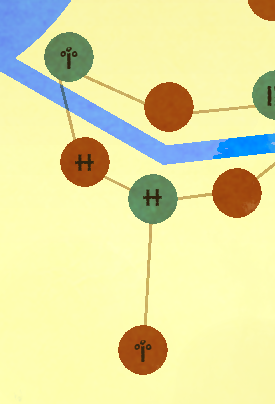
Notes on a map of Seshnela


This Seshnegi map dates to the reign of King Lofting IV of Seshnela. It displays many hallmarks of Rokari map-making, being highly stylised with geometric curves and straight lines and the west being oriented towards the top of the map, pointing to the location of the primeval Land of Logic.
The map displays no political borders, nor geographical precision, making the map useless for exploration or martial endeavours. It was likely that this map was produced for a trading house.
While originally coloured with rich pigments, the lack of any writing suggests it was for use by illiterate merchants. Settlements are instead marked with small coloured circles, with particularly important cities being marked with a rune indicating a particularly important resource located there.

Also included on the map are four mountains. Three are marked with stasis runes, referring to the dwarven held Iron mountains to the south, and the Nidan mountains to the north. The last mountain is marked with the darkness rune, indicating it represents the Uzgor mountains, and specifically Vulture's Peak.
The western islands of Old Seshnela have been to three, likely the three great islands of Pasos: Varskolin, Volonne, and Culonmac.


The Southern Reaches

While covering many different provinces, this is one of the most compressed areas of the map, with the rivalry and occasional wars between Seshnela and the Quinpolic League being completely ignored. Likely, the author of the map rarely came to the southern reaches of Seshnela, leaving him to consult on earlier maps.
From left to right, top to bottom:

Amneleon - This town can be identified by the use of the plant rune, referring to Amneleon's control over Seshnela's Tea production.

Unknown - Likely Urfenoswal, due to its administrative role over southern Seshnela.

Hathwal - Primarily identified from its famous Floating Markets, indicated by the trade rune.

Noloswal - One of the greatest port towns in Genertela, Noloswal recieves little acknowledgement from this map, being notified only by a trade rune. This is part of what cement's this map's Seshnegi origins.

Unknown - Likely Rinalket, a border town between the Quinpolic League and the Kingdom of Seshnela.

Sreborket - The plant rune likely indicates either the sorcerous gardens devised by the city's wizards, or its role in harvesting lumber from Tarinwood.


The Iron Path

Quite possibly the most important trade route in Genertela, this path from Rhis to Relamorket involves a dangerous and exhausting trek through the forested highlands of Noyelle. Many merchants have been forced to turn back by beast-folk who dwell in the highlands, but many more still risk the journey, for the sake of purchasing iron.
From top to bottom:

Rhis - Part of the Castle Coast, Rhis is famous for being the only place where dwarves are willing to trade iron, indicated by this town's death rune.

Priina - The seat of power for the Count of Deu, this city was presumably little more than a resting place for this map's author.

Voi - The harmony rune refers to this city's ancient Xemelan temple and healing springs.

Relamorket - Located at the convergence of the Tanier and Deu rivers, Relamorket is a major crossroads in Seshnela.


The Heartland

This stretch of the upper Tanisor and southern Rindland has been expanded, presumably the result of the map's author's familiarity with this region increasing it's importance. This region is home to many rich wheat farms, compared to the lower reaches' rice paddies. 
From left to right:

Arnlor - This city is home to both the treasury and royal mint, making it the source of Silver Imperials found all over Seshnela and Safelster. The city is also home to many powerful guilds, making this a likely origin for the map's author, and explaining it being signified by the trade rune.

Vetagane - While unmarked, Vetagane is easily identified as the only major settlement between Arnlor and Segurane.

Segurane - Painted in faded gold and bearing the mastery rune, Segurane of the Walls is easy to identify. Within the outermost wall lies the great markets and homes of crafters and merchants, making this one of the greatest centres of trade in Seshnela.


The Safelstran March

The borderlands between Seshnela and Safelster are fraught with danger, over the rivalries between the kingdom and the city states, but also extremely valuable. Ironically, since the Opening, the direction of trade has shifted, since it is now far cheaper to ship goods overseas instead of passing along the Manirian Road.
From top to bottom:

Fornalor - This city is home to some of the greatest stables in the west. The horse breeders here are notoriously exacting, breeding and selling horses that bear the noble colours of black, white, and grey.

Leplain - Painted in azure and marked with the law rune, this is obviously Leplain, city of wizards, and home to the greatest libraries outside of the city of Sog. The markets outside of the Blue Temple are always full of rare goods, for the Ekozite School of Alchemy both needs and produces some of the strangest items in Glorantha.

Dangk - This city is located near to Hrelar Amali, the ancient ruins worshipped by barbarians as the city of the gods. Many pagans still make pilgrimages to the ruins, making Dangk's markets full of foreign, if crude, goods.

Heswal - The trade rune here is an interesting case, for Heswal is more infamously known for the toll placed on all goods going between Seshnela and Safelster. However, on the shores of the river before the island city, merchants have created a shanty market for trading goods, hoping to make extra profit before they need to pay the toll.

Kustria - The death rune marking this city refers to the Great Tournament held here each year. The need for new arms and weapons marks this city as an excellent place to trade oxhides of bronze for other goods.


The North

This region was once the heart of Arkat's Dark Empire, but ever since the empire fell, the land turned to wilderness. Although reclaimed by a succession of Seshnegi monarchs, much of the land is still unsuitable for wheat and rice, leading it to become the home of rye fields  and sheep pastures.
From left to right:

Ukos - The death rune helps signify this town, and refers to its swordsmiths, who are the best in all Seshnela, with their bronze blades being sought after even in far off lands.

Isarnos - While not marked with any rune of importance, Isarnos does have a market, where they trade in devices copied from dwarven plans by adventurous (and somewhat foolish) wizards.

Harsad - Harsad was built to guard over the ruins of Arkhome, and guard it from barbarian grave robbers and Arkati sorcerers. Despite the best efforts of the town's soldiers and wizards, there still exists a black market for Arkati goods within the town.

Xeinar - The southmost point on the Old Imperial Road between Seshnela and Fronela, Xeinar has never profited from this trade. This is because, due to the ancient rituals involved in taking the road, the inhabitants of this town never interact with those travelling between the two nations.


Far Tarins

This province of Loskalm being appearing on the map helps cement the dating of it to Lofting IV's reign, since it was only freed from the ban a mere eight years before his reign, and there would be little land trade between Seshnela and Tarins for years afterwards. This may in fact be the earliest Seshnegi map after the Ban and Opening to show the province.
From top to bottom:

Southpoint - The law rune helps identify this city as the home of the High Watcher of Hrestolism. Despite this, the author's Rokari bias can be seen by treating Southpoint as just another city, without the azure given to Leplain.

Isefwal - Once almost deserted, Isefwal grew into a thriving port once the Opening of the Oceans took place. It's role as the entryway for goods into Loskalm is noted by the trade rune.

Unknown - While likely Tarnwall, this may instead be Omphis, with no identifying symbols to hide that city's role in teaching Men-of-All, considered blasphemous by Rokari.

Midtasker - Although an important Tarins city, Midtasker receives little acknowledgement here, possible reasons include the author distrusting the ancient graves found here, it's importance to the old Middle Sea Empire of the second age, or a disagreement with a local merchant.

Svenlos - Svenlos is the northern edge of the Old Imperial Road, the only safe route through the dangerous Erontree forest. While surrounded by orchards, little of that is recorded here.


Special thanks to Kalin Kadiev for improving the appearance of the map.

Monday, 1 February 2016

New Pelorian

"When a nomad wants to talk of home, when a servant wants to talk of freedom, when a priest wants to talk of the world, or when a merchant wants to talk of gods; they use New Pelorian. It is a language which turns the unknown into the known, turns the strange into the familiar, and the foreign into the intimate. New Pelorian is the greatest gift of the Goddess, for it reveals that We Are All Us." - Poem by anonymous author.

Before the Goddess was reborn, there were three great languages found in Peloria:
  • In the centre was the ancient tongue of Dara Happa, inflexible and exacting, they claimed it was the original tongue of all people. To make the unchanging runes, the Buseri scribes used reed pens pressed into soft clay which was then baked; or carved with chisel and hammer into raw stone.
  • In the west was the strange sounding language brought by the Carmanians. They claimed it was the original tongue of all people. The glyphs used by the Carmanian wizards were painted on papyrus scrolls, made from the reeds around Lake Oronin.
  • In the south came the barbaric Therelmic tongue, which was used in Sylila and the other storm worshipping lands. They claimed it was the original tongue of all people. The ancient symbols were inscribed into wood, and scratched into the hides of animals by the Greybeard sages.
The Goddess saw this, and knew that each language was wrong, but also right. They could not all be the original tongue of all people, but they each contained seed from it. Each had a written form, but they were hidden away by knowledge hoarding cults.

The Goddess sent her daughter, the Great Sister Deneskerva, to find the truth hidden within the languages, so that her message could be spread to one and all, sage and savage. Deneskerva went abroad the fledgling Empire to speak and listen to all those who would talk with her. She heard their words, and found the right ones within them, the words that would be the True Language of the Goddess. When she had them, she went to a scribe to build that tongue. Together, she and the scribe also shaped the Dara Happan runic script into something that could be written on papyrus.

The result, New Pelorian, was a language unlike any other in Glorantha. Its words came from languages all across Peloria, but healed and repaired, so that they were as one. Although one word may come from Carmanian, and another from Dara Happan, through the miracle of the Great Sister, they could be used and understood together, as if they were always meant to be.

The Great Sister spoke to the missionaries of the Red Goddess, instructing them in this new language, which they shared with the people they went to enlighten. Its perfection made it easy to learn, and soon the foreigners could understand the missionaries perfectly. The missionaries were also able to carry sacred texts with them, for papyrus was much lighter than clay tablets.

Within the Empire, the script and words were shared with the scribes of Irippi Ontor, who were not afraid of change like other scribes. They used it to translate the ancient texts into new scrolls that could be read by anyone. They taught it to workers, to priests, and to nobles. Even when their own language was sufficient amongst their own people, New Pelorian was used to speak to foreigners, to record information, and to read the words usually kept hidden by the old priests.


The symbols of New Pelorian
New Pelorian's script was derived from the ancient Dara Happan Sacred Alphabet, but altered to make it easier to learn, read, and write. Allowing literacy to spread like wildfire.


Z        Little changed from the original Dara Happan rune, being only altered to use a pair of strokes.

T        This glyph has not fundamentally changed from the Sacred Alphabet.
U        The bottom part of this glyph has been left off, while the rest has been rounded into a simple loop.

R        This glyph has not fundamentally changed from the Sacred Alphabet.
L/Y        The ancient runes L and Y were simple dots within a square and triangle. New Pelorian has merged the two symbols, if not the sounds themselves (usually), by replacing the containers with the celestial circle.
Th        This glyph has been rounded, and the two sides have been fused at the top for less strokes to be required.
F        Once a diamond with a small line within, the line has been lengthened, and the diamond rounded into a glyph resembling the Moon Rune.
P        The bottom side branches of  this glyph has been left off, while the rest has been rounded into a simple loop.
I        The crossbars have formed a loop to the right of the glyph.
E/V   This glyph still resembles the Dara Happan rune for E, even though it has absorbed the rune for V. This has resulted in a "paddy field" effect for some names, like Everina, the goddess of rice.
M       This glyph has not fundamentally changed from the Sacred Alphabet.
       The lower half of this glyph has been rounded.
      The left and right extremes of this glyph have become more flamboyant, but otherwise it has changed little.
A       This glyph combines both the old A rune of the alphabet, with the feminine suffix which made the same sound, while simplifying both.
H       Like many others, this rune has been rounded, especially at the bottom.
G       This glyph has changed little, with only the characteristic rounding having taken place.
N       This glyph has not fundamentally changed from the Sacred Alphabet.
      Like the glyph for L, the old Dara Happan D rune has been rounded, turning a oblong into a circle.
Sh      This glyph has changed little, with only the characteristic rounding having taken place.
        The top crossbar has merged with the upper limbs of this glyph, which have themselves been curved, making it resemble a staff with an inverted stasis rune atop it.
Qu      The wings of the ancient rune have become a continuous loop, with the dark core being replaced by light.
W       While the crossbar has remained unchanged, the diagonals have become curves.
       The lower strokes of the ancient rune have gone, taking it to a simple glyph.
K        The diagonal stroke to the top right has been eliminated from the ancient rune, and its form exaggerated into the modern glyph.

Monday, 18 January 2016

Vrimak

Vrimak depicted in the common Anaxial-era style.
Mythos and History
Vrimak first flew through the skies when the world was young. He was the Bright Eagle Lord, who carried the All-Seeing Eye within his talons. He did not land, for he was a creation of the Pure Light, and could fly even when asleep.
It was only when he looked down, and saw Avarnia, goddess of ancient Jarasan. Her beauty was unmatched in all the world, and not even the glories of the sky could match her grace. Vrimak descended through the sky, descended through the air, until his talons touched the ground.
Vrimak romanced Avarnia, and their children filled the land of Jarasan. From the running birds, to the soaring birds, the land was bountiful, and Vrimak returned to the sky, taking Avarnia with him as his bride.
As children of the High Flyer, all of Jarasan worshipped birds. The men rode upon the greatest of the Tall Birds, and were mighty hunters and warriors; the women danced among the plump birds, and provided life to the land. All was good until the serpent came.
The serpent slithered across the land, devouring all that was good. All that flew retreated to the sky to be with Vrimak, leaving only the Tall Birds, and the people.
As the people despaired, a man came amongst them. He proclaimed himself child of the All-Seeing Eye, and carried fire within his breast. He bound the serpent up with earth and shovels, but the serpent was clever, and hid inside the man, although no one knew.
All of Jarasan thanked the man, who called himself Murharzarm. He gave the people the gift of worship, allowing them to fly up to reach the sky to meet with the gods. Murharzarm was so worthy that the gods themselves descended from the sky to pay him homage. Even great Vrimak roosted upon Murharzarm's arm, declaring him to be his successor, the second Bright Eagle Lord, and that all should follow him.
One of Vrimak's children was not like the others. Where they were bright and glorious, she was dark and spiteful. Where they bore feathers of great beauty, she wore nothing like a worm. She was called Mahaquata, and had long since left the gaze of her father. When she saw Murharzarm who had tamed the serpent, she was angry, as she always was when someone could do what she could not. She met with others, such as Blows From Within and the Armless Howler, and conspired with them.
They took everything that was wrong, and evil, and impure, and created a weapon. They then entered the home of Murharzarm, and while Mahaquata distracted her father, the others plunged their weapon into Murharzarm's chest.
When Murharzarm died, everything went wrong.
Vrimak returned to the sky, despairing at the corruption of his kin. The conspirators fled in shame and horror of what they did, and all the people of Murharzarm fell upon each other in fear. The serpent, BernEel Arashagern, now freed once again, burst its boundaries to devour the world.
Fortunately, Murharzarm had a son, Jethsarum. He had been trained by his father in the arts of rulership, trained by his uncle the Red Planet in the arts of war, and trained by Vrimak in the arts of devotion. He bound BernEel Arashagern as his father did, and when the serpent tried to escape, used violence to force it to stay.
He was elected by the people as the next Bright Eagle Lord, in his father's place, and he ruled justly. But the serpent had a mother, the Mother of All Serpents, she of the blue blood and dark heart. She would crush and devour all of the world in vengeance, so Jethsarum sent his people to live on the great ship with others, while he went to face her. He died, but saved the world in doing so, so made Vrimak proud.
After Jethsarum's death, the master of the great ship assumed the role of leader, although no one ever proclaimed him Bright Eagle Lord. When they saw it was safe to return, the gods of Jarasan took the people within their claws, and departed the ship. They found the ancient city of Verapur within the lands, and Vrimak sent his son Tholm to roost within its temple. Jethsarum now had a statue before the temple of Vrimak, to bless the city, and protect it from serpents. Verapur was the jewel of the world, and the lords of east and west both came to grace it with their presence.
But goodness never stays. Although Verapur was bright, the world was not. Kestinoros, the newly crowned Bright Eagle Lord and descendent of Jethsarum, saw this when he spoke with Tholm, Vrimak's messenger. He saw the monsters coming from the north, the children of Mahaquata and worse things, and they were bringing with them a castle of ice.
Kestinoros sought the greatest soldiers in the world to war against these monsters, that he called the Erkarkest, but the others refused. They did not fear what they could not see, and would not risk danger. Knowing that Jarasan could not hold out alone, Kestinoros sent his people south, with Tholm to protect them, while he took his soldiers north to face the Erkarkest.
When Kestinoros did not return, the people knew that they were doomed, and went to Tholm, to beg for his protection. Tholm spoke with his father, Vrimak, who descended downwards once more. At first, people were frightened by his brightness, but then they saw him darken with sorrow. His wings turned black, his beak became obsidian, until only his burning eyes remained visible, as his wings mantled everyone. This was Vrimak the Night Eagle, who would protect his people with sorrow, as the world outside turned to ice and ash.
By the time the Erkarkest were gone, and Vrimak had lifted his wings once more, the people were lost. They did not know their faces from those of their neighbour, and had forgotten how to worship vrimak. They followed whatever lords and gods would protect them, and Vrimak no longer shone, nor carried the All-Seeing Eye.
It was only much later, when the people were labouring under many horse worshippers, when they discovered who they were. A man came amongst them, who called himself Avivath the spearman. He fled the horse worshippers, who intended to kill him, for he knew of the Truth. He showed the people of the land about Vrimak and Tholm and showed them how to worship the gods correctly. In one hand he bore the All-Seeing Eye, that he called Antirius; and in the other he carried the Roost of Tholm, upon which the Hawk God perched. He renamed the land Kestinaddi, after the Roost. He named a youth as the Bright Eagle Lord, and the land became well.
When the All-Seeing Eye returned to the Sky, Vrimak took it once again in his talons, and carried it from west to east, only stopping once, when the people of the land called on Avarnia to woo him once more, that they might birth a perfect god once more from the cosmic egg.
Ever since then, the people of Kestinaddi have risen and fallen, with even the name changing to Rinliddi, but Vrimak has remained in the skies.


Nature of the Cult
Lunar-style statue of Vrimak
Vrimak is the Celestial Eagle, the bearer of the All-Seeing Eye on its journey across the heavens. All across Peloria he is recognised as one of the portions of Yelm, and so his avian children are given pride of place across the land.
After death, his worshippers know that they will join with the birds of the sky world, becoming magnificent of plumage, and beings of pure fire.

Depiction
Vrimak is depicted as either a bird, or as man with the head and wings of a bird. While many Rinliddi families depict Vrimak as their ancestral bird, he is most commonly seen as the golden Sun Eagle of Peloria. He is often on fire, as befits a sky god, and sometimes bears the All-Seeing Eye within his talons or hands.
Plentonius identified the fourteenth figure of the first row of the Gods Wall with Vrimak, although later scholars have claimed this is his son Tholm (who Plentonius identified as figure seventeen of that row.)


Runes
Vrimak is the source of the Bird Rune, a specialization of the Beast Rune. He is also strongly associated with the Sky Rune.

Sky Rune
Vrimak is the Lord of the Above, the Bearer of the All-Seeing Eye, and the Wings of Shining Heaven.
His initiates are known to use the Sky Rune to illuminate their surroundings, make their swords burst into flames, reveal hidden things with the rays of the sun, see in darkness, and terrify creatures of darkness. Unusually for Solar cults, they may also use their Sky Rune to scare and burn horses.
Worshippers who are powerful in the Sky Rune Affinity are loyal, honest, and pure.


Bird Rune
Vrimak is the Father of Birds, the God of Eagles, and the High Flyer. He is the source of the Bird Rune, and his initiates can make a very broad use of its powers. His initiates are known to use the Bird Rune to speak to and command birds, grow mighty wings, change their head into that of a hawk, spot enemies at a distance, breed fine hawks, heal birds, and to summon and command lesser bird gods.
Worshippers who are powerful in the Bird Rune Affinity are just and merciless.

Particular Likes and Dislikes
Vrimak is friendly with most other gods of fire and the sky. Especially honoured is Murharzarm and his father the All-Seeing Eye (who the Dara Happans call Yelm), who Vrimak bestowed his favour. It is common for noblemen of Rinliddi blood to worship both Vrimak and Murharzarm. Also favoured is Shargash, god of the Red Planet, and uncle of Jethsarum. He is better known to the Rinliddi as Vaskaru the warrior.
The darkness is hated by Vrimak, in part because it was his daughter who brought it into existence. His worshippers will rarely have non-violent relations with any creature or worshipper of darkness.
The greatest foe of Vrimak are the serpents, that is viewed with the same vehemence other cults save for Chaos. The serpents include water gods, dragons, and other vile and low creatures.


Cult Organization and Holy Places
Rural Rinliddi shrine to Vrimak
The cult of Vrimak has a very loose structure, with each city in Rinliddi having its own traditions and rituals derived from those given by Avivath. While there's no official hierarchy, traditionally the high priest of Diavizzi has primacy over the high priests of other cities.
All priests acknowledge the Bright Eagle Lord, Vrimak's representative in the world, as their superior. This position is normally synonymous with that of the Emperor of Dara Happa, but on occasions when Dara Happa has been seduced by darkness or serpents, Rinliddi has remained pure, and a new Bright Eagle Lord has been chosen by the gods.
Vrimak's temples are circular towers, guarding a paradisal garden within, where birds of all kinds congregate in harmony.
The greatest of these towers is in Diavizzi, and is said to enclose the roost of Tholm when it is not being held by the current Bright Eagle Lord. The high priest of Diavizzi knows the truth, that the temple itself is in fact Tholm's roost, and that each supplicant who wishes to beome the Bright Eagle Lord must visit the temple to commune with Tholm and Vrimak.

Priests
Vrimak's priests, also known as Resplendent Ones for their brightly decorated feathered robes, are now a common sight in the cities of First Blessed. Where once they donned their garments in secret, fearing Pentan or Dara Happan reprisal, the Resplendent Ones now perform their ritual dances upon the re-sanctified temples of Vrimak.

Holy Days and Sacrifices
Vrimak has four major holy days, taking place on the equinoxes and solstices. On the Ninth day of Sacred Time, Vrimak's cult holds Egg Day, celebrating when Vrimak hatched from the cosmic egg to oversee the world. The festivities involve grand feasts, usually consisting of egg dishes sweetened with dried fruit.
On the eighth day of the sixth week of Youth Season (Fireday of Harmony Week in Fire Season) is the Summer Solstice, marking Vrimak's High Holy Day. This day has largely been eclipsed by Yelm's celebration, but Vrimak's temples are still open for Zenith Day, marking the point when Vrimak reached the apex of the sky on his flight. Feathered sashes are given out to the masses, and even during the most solemn of Yelm festivities, the people can be seen covered in the brightly coloured garments.
On the second day of the first week of Harvest Season (The Waterday of Stasis Week in Earth Season), the Rindliddi celebrate Nest Day, when Avarnia romanced Vrimak, and the celestial couple became one. On this day, Rinliddi woman are allowed to ask men to marry them, in what one Dara Happan emissary described as "Near Ulerian levels of debauchery."
The fifth day of the first week of Dying Season is called Mantling Day (The Fireday of Illusion Weak in Dark Season.) As the Winter Solstice, the day is sacred to the Night Eagle aspect of Vrimak, and commemorates when he wrapped his wings around the desperate exiles from ancient Jarasan. (The Dara Happans claim this is a misidentification of the Roof of Manarlavus) On this day, the Rinliddi try to stay indoors when possible, and weep for those brave enough to stand against the glacier.


Initiates
  • A Prospective initiate must have a Sky Rune or Bird Rune rating of at least 1w.
  • While most Vrimak initiates are men, women are not technically forbidden from the cult, and numbers of them have been increasing since the rise of the Red Moon.
Subcults
Most temples to Vrimak are centred around the worship of one or more of his children. Here are some of the more common subcults found in Rinliddi:

Jethsarum
Jethsarum is the High Heat, son of Murharzarm, nephew of Shargash, and slayer of serpents. When the Serpent tried to devour the world, he used the rituals of his father, and the spear of his uncle to bind it into impotence. When the Mother of All Serpents came, he stood with his uncle to defy her, while the good people fled. His cult provides the Enemy of Serpents Feat.

Night Eagle
Vrimak became the Night Eagle when all was lost, and the world grew dark. He took his wings and mantled the survivors of the serpents, of the Erkarkest, and other horrors. He kept them safe, when only his eyes could provide light. Worshippers can use their Sky Rune affinity to be the light in darkness.
Pre-Jenarong era statuette of Veng
Tholm
Tholm is the Descender Hawk, the god of falconry, and is visible as the rays of the sun. He is the intermediary between Vrimak and humanity, and much of Rinliddi can trace their descent from him. His worshippers can use their Bird Rune to become a hawk.

Veng
Veng is the god of Avilry, trained by Shargash in the arts of war. He rides upon the ancient augner birds, and has been persecuted since before the dawn. Only with the coming of the Red Goddess has his temples been reopened, and only with her blessing have the augners been reborn. His worshippers can use their Bird Rune affinity to hatch augners, and to aid riding them.


Devotees
  • An initiate of Vrimak with a rating of 11W in their Divine Rune Affinity may dedicate themselves completely to Vrimak and become a devotee.
  • Devotees are subject to the usual restrictions.

Feats
Devotees of Vrimak may perform magical feats: repetitions of his mythic deeds. Some feats are universal to the Vrimak cult, others are associated with a particular subcult.

All-Seeing Eye
Within his talons, Vrimak grasps the sun, the great All-Seeing Eye. His foes cower and prostrate themselves beneath it, for they cannot hide their foulness from his sight. Any who are impure who approach him will find themselves cleansed and burned by its brightness, but while holding the All-Seeing Eye, Vrimak cannot ignore what he sees, even when it drives him to despair.

Paradisal Aviator
As the dancer in the skies, Vrimak is the the lord of flight. He gave wings to the planets so that they might dance around him; he raised his lover Avarnia to the skies, so that they would no longer be apart; and when the Erkarkest were revealed, he stripped them of their wings and drove them to the ground. All who fly do so at Vrimak's whim, and any who displease him, he may send plummeting downwards, while raising up those he blesses.

Enemy of Serpents
Jethsarum was the great enemy of Serpents. He bound BernEel Arashagern, the Arcos River; and confronted the mother of all serpents. With his spear Entika, he could strike the secret parts, and make their life blood run free. While he stands against them, they cannot ignore him. While he wields his spear, they cannot fight others. And so he is their greatest enemy.


Lesser Bird Gods
All birds, even the least worthy, have a spark of the divine within them. The divine ancestors of the birds still dwell within the sky world, and worshippers of Vrimak can summon and command many of them.

Ivory Kestarthi charm
Kestarthi
The Kestarthi are the last children of Vrimak and Arvania, who ascended with their parents to the Sky World to provide beauty. The strongest Kestarthi are minor gods in their own right, and descended once again to aid the people of Rinliddi by carrying the words of Vrimak to them.
In their native Sky World, the Keskarthi resemble birds of every kind, made of living flame. Many of them can also take the form of a Rinliddi nobleman, but with the head and wings of a bird.
The Dara Happans count the Kestarthi as one of the many hosts of Certami.

Erkarkest
The Erkarkest are the evil false-birds, who aided Mahaquata to slay the glorious sun. For their crimes, they were stripped of their wings, and sent to crawl upon the ground like serpents. Despairing over their blasphemy, they crawled into the forbidden places, and are fit only to be hunted and killed.
The God Learners, on hearing of the Erkarkest, proclaimed the Durulz of Maniria to be their descendent. Despite this the Rinliddi use the name much as others would use demon, monster, or krjalki; and include bats, trolls, and even pentans as forms of Erkarkest.

Monday, 11 January 2016

Moonstones


Inspired by discussion on the Glorantha Google+ page here

Gold and Carnelian broach depicting the Red Goddess.
The term Moonstone is used within Glorantha to refer to a wide variety of objects. From the nearly mundane pieces of sard and onyx used as jewellery by the lesser nobility of Peloria, to the myriad charms used by the unkindled lunar worshippers, the term can refer to almost any stone; although usually only those of red, black, white, and blue are considered truly sacred.
However, these moonstones are pale reflections of true Moonstones, just as spirits and spells are pale reflections of the true magic of the Red Goddess.
True Moonstones are said to have come from the Red Moon itself, and can take nearly any form or substance; making it easier to understand how the lesser or false moonstones could be mistaken for the real thing.

What sets them apart is their power. Each Moonstone seems to glow with the light of the Red Goddess in one of her seven phases, even those associated with the dying or black moons shine a contradictory bright shadow. Lunars who have kindled their Moon Rune find this spiritual radiance calming, and those who have been crazed by Occlusion can find their madness quieted when in its presence. The Orlanthi claim to find the glow of a Moonstone irritating, and attribute this to the Moon's Chaotic nature. At least one instance of kinstrife has been blamed on poisoning by powdered Moonstone.

The effects of Moonstones have been well attested, if not well understood:
  • The Moonstone may be used to summon a Lune, much as a shade can be summoned from a pool of darkness, or a campfire can be used to give birth to a salamander. The stone will typically crumble after use, or at least be lessened by the summoning.
  • The Moonstone can be used to to craft a Glamour as if the Moon was full. The Moonstone can only be used a few times for this purpose before it crumbles to dust.
  • Even those whose Moon Runes are not kindled can use a Moonstone to create an Evocation based upon the phase of the Moon the Moonstone is associated with. The Moonstone is always consumed by this. Regardless of the phase of the moon, this is always a stretch.


Natural Moonstone prism.
What only the most Illuminated understand about the Moonstones, is that they are not truly real.

Each Moonstone is a fragment of the Red Moon's power, substantiated in Glorantha. They are solidified Lunar magic, a Glamour made manifest. As such, they can be unwoven from their material shape, and used to shape Glamours. When used to summon a Lune, the Moonstone is instead rewoven into the form of a Lune, and some say that Lunes can be turned into Moonstones in turn.

Because Moonstones are a form of Glamour, Moonstones can be created by powerful magicians, such as the Crater Makers.  The making of Moonstones is an exhaustive process, and even then the Moonstone is lesser than those created by the Goddess and her attendants, and will fade eventually.


This of course, leads to a further revelation. As Moonstones are made from the same substance as the Red Moon, and as Moonstones are a form of Glamour; the Red Moon itself is a Great Glamour, woven by the Red Goddess to be her footstool when she ascended. This is why it waxes and wanes with the Lunar cycle, not as its cause, but as its symptom. The Goddess Rufelza, seen as the material aspect of the Red Goddess, can also be seen as the Lune manifested as the Red Moon.


Blue Moonstones
Blue Moonstones, also known as Dead Moonstones are superficially similar to normal Moonstones. They give off a spiritual light and are connected to the ancient Blue Moon of the gods age. Despite the name, Blue Moonstones are rarely blue, instead being a dull grey. It is only when viewed with magical senses, that the deep blue light they give off becomes visible.

Unlike regular Moonstones, Blue Moonstones cannot be used to create Evocations, nor can they aid the creation of other forms of Glamour.
Instead of a Lune, a Blue Moonstone may be used to summon a Selene, also known as a Dead Elemental. These spirits are invisible to normal vision, but are all too real when they engulf their victim. Those unfortunate enough to be swallowed by a Selene slowly has their soul unravelled. Their fire goes out, their breath becomes shallow, their body becomes withered and frail.
They can only take form from the invisible light of a Blue Moonstone, making them thankfully rare.