Showing posts with label Malkioni. Show all posts

Monday, 6 March 2017

The House of Black Arkat


Mythos and History
When Arkat Liberated the Shadowlands, he revealed many previously unknown secrets.
Most could not grasp them, and viewed them as simply another facet of Arkat's greatness, but a few could understand what Arkat spoke of, and wanted to learn more.
Arkat brought these worthies together, both Uz and Man, and taught them the true nature of the cosmos.
All existence was born from the great darkness, Xentha, who is the mother of all. Here, everything was bliss: the Earth was nurturing, soft and warm; there was no hunger, pain, or strife.
And then came the Deceiver, Gbaji.
Arkat depicted as a Half-Troll
Arkat declared that Gbaji was known by many masks: Evil Emperor, Teller of Lies, Most Bad Man, and now Nysalor.
Gbaji was all that Xentha was not, he was still, barren, bright, hard and hollow. And he envied Xentha. He declared all that Xentha was as wrong, and that he was the only right. He led many of Xentha's children away, into a world of pain, sorrow, and harshness.
Arkat's followers were shocked to discover this was the world they now lived in.
Those who did not flee in horror, were taught by Arkat how they could manipulate this world of Gbaji, to break his deceptions and reveal the truth. He showed how everything was made from the raw darkness, allowing them to turn earth to air, and air to water, for all was originally darkness.
When Arkat went north, to take the fight to Gbaji, many of his followers remained, to teach the truth to those who would listen.
They wrote down his teachings, and kept them in a great temple they named Arkat's Hold after their teacher, and so in turn they became known as the House of Black Arkat.
Here they have remained.
Even when the God Learners invaded, they were never able to breach the walls of Arkat's Hold, and when they fell, the House of Black Arkat was opened once again.

Nature of the House
Arkat was the greatest hero ever to walk Glorantha. He was many things in his lifetime. Man, troll, knight, berserker, liberator, deceiver, king and devil. He betrayed his closest friends and allies in order to save the world.
His followers are sorcerers, mystics, and scholars.

Particular Likes and Dislikes
The House's oldest and greatest allies are the cults of darkness, especially the cults of Argan Argar -- who came before Arkat and was Xentha's son, and Zorak Zoran -- who is one of the greatest enemies of Chaos. The House is also friendly to most Esrolian cults, if for no other reason than to ensure the sanctity of Arkat's Hold.
The House is usually reviled by cults of light and sky, who view Arkat's message as blasphemy. Likewise, the House treats them with disdain, viewing them as those most wrapped up in Gbaji's Deceptions. Only against the cults of Chaos will the Arkati willingly ally with those who follow the sun.

House Organization
The House has no single authority. Each Mage has effective independence from the others, students are free to listen to whichever Mage they wish. The wizards of the House in truth have only one master, Arkat himself.
Unknown to most Gloranthans, a single chapter of the House has been established deep within the Troll Woods in Heortland. Here the near-human Kitori learn the Arkati arts, at the feet of a displaced Arkati Mage.

Holy Days
The House has no specific holy days or nights, but the cult acknowledges Freezeday as a naturally potent time to perform many of their rituals.

Sample Grimoires
The House of Black Arkat holds within its libraries many different ancient texts written by a multitude of sources, including the followers of Arkat, and even the Great Hero himself. Few Arkati will know even half of the hidden lore kept within their walls, but this pair of grimoires are those most commonly used by sorcerers of the House of Black Arkat:

The Lead Grimoire
This grimoire describes the metal of darkness, the bones of Xentha, the material form of the Darkness Rune, which was used to make the foundation of the world. By studying this grimoire, sorcerers can learn how to manipulate this substance, as well as the raw darkness itself. Sample spells include:
  • Enchant Lead: This spell summons the Darkness Rune to fill a leaden object, cleansing it of impurities, and turning it into enchanted form of the Rune Metal.
  • Project Senses: This spell combines the Darkness Rune with the Truth Rune, allowing the sorcerer to send their senses into a patch of shadow, allowing them to see and hear everything as if they were inside the shadows.
  • Sense Lead: This spell commands the Darkness Rune within all nearby sources of lead to make themselves known. The sorcerer can then find the lead through the supernatural inky patches created.
  • Shape Lead: This spell combines the Darkness Rune within lead with the Movement Rune, allowing the sorcerer to mould and form the metal is if it were clay, and then to set it into a new shape.
  • Solidify Darkness: This spell combines the Darkness Rune within a patch of shadow with the Stasis Rune, allowing the sorcerer to touch and manipulate the shadows as if they were a solid object.
  • Summon Shade: This spell summons the Darkness Rune into a shadow, animating it to perform the sorcerer's will.

The Hepherones Texts
This series of first age Rinliddi scrolls predates Arkat, and is said to have been war booty gained during his invasion of Peloria. The texts were cleansed, purified, and examined for Truth. The resulting documents and exegesis form a grimoire that the Arkati use to manipulate the connection between the Middle World and the Other Side. Spells derived from the text include:
  • Dominate Spirit: This spell commands the Magic Rune within a spirit, allowing the sorcerer to give it irresistible commands.
  • Enhance Spirit: This spell summons the Magic Rune into a spirit, strengthening and reinforcing them, granting them temporary extra power.
  • Mystic Vision: This spell combines the sorcerer's Magic Rune with the Truth Rune, connecting the sorcerer's own connection with the Other Side, allowing them to sense the magical abilities of living creatures and objects.
  • Neutralize Magic: This spell dismisses the Magic Rune within an existing spell or other magical effect, cutting off its connection with the Other Side, and causing it to fail.
  • Protective Circle: This spell combines the Magic Rune with the Stasis Rune, creating an invisible, intangible wall around the sorcerer. This wall resists all magic passing one way or another, creating a sanctuary for the sorcerer.
  • Summon Spirit: This spell summons the Magic Rune, creating a connection with a known and named spirit, allowing the sorcerer to call them into the world.


Illumination
Although they would never use the term themselves, the House of Black Arkat is also a source of Illumination. Arkat's teachings of the original cosmos, before Gbaji's separation, provides the mystical awakening similar to Nysalorian Illumination. The House of Black Arkat prefers the terms gnosis, or wisdom, to refer to this state.
This allows members of the House to do many things others would regard as impossible, including uniting opposing powers and elements (as all things are merely a part of the original darkness; and joining cults normally opposed to each other, such as Argan Argar and Veskarthan (for the Illuminate knows that their feud is nothing before the cosmic truths.)
Most members who become Illuminated do so through their Darkness Rune, but other paths have occasionally occurred.

Esrolian Arkati, meditating on the Gods' War through the wisdom of Arkat.


Mage
A member of the House of Black Arkat with a rating of 11W or more in one of his grimoires, who has also become Illuminated may seek to become a Mage of the House.
Mages of the House of Black Arkat otherwise function as per the rules in HeroQuest: Glorantha, page 174.
Few Mages ever leave the walls of Arkat's Hold via its gates. Most spend their time in meditation and education, teaching the less learned of Arkat's secrets.
When they do leave Arkat's Hold, it is usually only to venture to the Other Side, to thwart Gbaji's deception and to seek the original world.
With the coming of the Hero Wars, this state of affairs will not be able to last, and the Mages of Arkat will be forced to refute Gbaji's deceptions directly.

Sunday, 14 February 2016

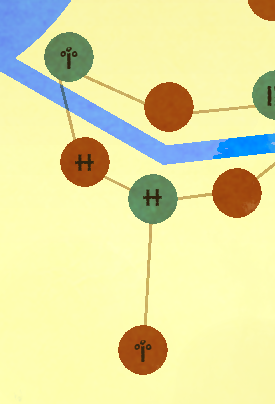
Notes on a map of Seshnela


This Seshnegi map dates to the reign of King Lofting IV of Seshnela. It displays many hallmarks of Rokari map-making, being highly stylised with geometric curves and straight lines and the west being oriented towards the top of the map, pointing to the location of the primeval Land of Logic.
The map displays no political borders, nor geographical precision, making the map useless for exploration or martial endeavours. It was likely that this map was produced for a trading house.
While originally coloured with rich pigments, the lack of any writing suggests it was for use by illiterate merchants. Settlements are instead marked with small coloured circles, with particularly important cities being marked with a rune indicating a particularly important resource located there.

Also included on the map are four mountains. Three are marked with stasis runes, referring to the dwarven held Iron mountains to the south, and the Nidan mountains to the north. The last mountain is marked with the darkness rune, indicating it represents the Uzgor mountains, and specifically Vulture's Peak.
The western islands of Old Seshnela have been to three, likely the three great islands of Pasos: Varskolin, Volonne, and Culonmac.


The Southern Reaches

While covering many different provinces, this is one of the most compressed areas of the map, with the rivalry and occasional wars between Seshnela and the Quinpolic League being completely ignored. Likely, the author of the map rarely came to the southern reaches of Seshnela, leaving him to consult on earlier maps.
From left to right, top to bottom:

Amneleon - This town can be identified by the use of the plant rune, referring to Amneleon's control over Seshnela's Tea production.

Unknown - Likely Urfenoswal, due to its administrative role over southern Seshnela.

Hathwal - Primarily identified from its famous Floating Markets, indicated by the trade rune.

Noloswal - One of the greatest port towns in Genertela, Noloswal recieves little acknowledgement from this map, being notified only by a trade rune. This is part of what cement's this map's Seshnegi origins.

Unknown - Likely Rinalket, a border town between the Quinpolic League and the Kingdom of Seshnela.

Sreborket - The plant rune likely indicates either the sorcerous gardens devised by the city's wizards, or its role in harvesting lumber from Tarinwood.


The Iron Path

Quite possibly the most important trade route in Genertela, this path from Rhis to Relamorket involves a dangerous and exhausting trek through the forested highlands of Noyelle. Many merchants have been forced to turn back by beast-folk who dwell in the highlands, but many more still risk the journey, for the sake of purchasing iron.
From top to bottom:

Rhis - Part of the Castle Coast, Rhis is famous for being the only place where dwarves are willing to trade iron, indicated by this town's death rune.

Priina - The seat of power for the Count of Deu, this city was presumably little more than a resting place for this map's author.

Voi - The harmony rune refers to this city's ancient Xemelan temple and healing springs.

Relamorket - Located at the convergence of the Tanier and Deu rivers, Relamorket is a major crossroads in Seshnela.


The Heartland

This stretch of the upper Tanisor and southern Rindland has been expanded, presumably the result of the map's author's familiarity with this region increasing it's importance. This region is home to many rich wheat farms, compared to the lower reaches' rice paddies. 
From left to right:

Arnlor - This city is home to both the treasury and royal mint, making it the source of Silver Imperials found all over Seshnela and Safelster. The city is also home to many powerful guilds, making this a likely origin for the map's author, and explaining it being signified by the trade rune.

Vetagane - While unmarked, Vetagane is easily identified as the only major settlement between Arnlor and Segurane.

Segurane - Painted in faded gold and bearing the mastery rune, Segurane of the Walls is easy to identify. Within the outermost wall lies the great markets and homes of crafters and merchants, making this one of the greatest centres of trade in Seshnela.


The Safelstran March

The borderlands between Seshnela and Safelster are fraught with danger, over the rivalries between the kingdom and the city states, but also extremely valuable. Ironically, since the Opening, the direction of trade has shifted, since it is now far cheaper to ship goods overseas instead of passing along the Manirian Road.
From top to bottom:

Fornalor - This city is home to some of the greatest stables in the west. The horse breeders here are notoriously exacting, breeding and selling horses that bear the noble colours of black, white, and grey.

Leplain - Painted in azure and marked with the law rune, this is obviously Leplain, city of wizards, and home to the greatest libraries outside of the city of Sog. The markets outside of the Blue Temple are always full of rare goods, for the Ekozite School of Alchemy both needs and produces some of the strangest items in Glorantha.

Dangk - This city is located near to Hrelar Amali, the ancient ruins worshipped by barbarians as the city of the gods. Many pagans still make pilgrimages to the ruins, making Dangk's markets full of foreign, if crude, goods.

Heswal - The trade rune here is an interesting case, for Heswal is more infamously known for the toll placed on all goods going between Seshnela and Safelster. However, on the shores of the river before the island city, merchants have created a shanty market for trading goods, hoping to make extra profit before they need to pay the toll.

Kustria - The death rune marking this city refers to the Great Tournament held here each year. The need for new arms and weapons marks this city as an excellent place to trade oxhides of bronze for other goods.


The North

This region was once the heart of Arkat's Dark Empire, but ever since the empire fell, the land turned to wilderness. Although reclaimed by a succession of Seshnegi monarchs, much of the land is still unsuitable for wheat and rice, leading it to become the home of rye fields  and sheep pastures.
From left to right:

Ukos - The death rune helps signify this town, and refers to its swordsmiths, who are the best in all Seshnela, with their bronze blades being sought after even in far off lands.

Isarnos - While not marked with any rune of importance, Isarnos does have a market, where they trade in devices copied from dwarven plans by adventurous (and somewhat foolish) wizards.

Harsad - Harsad was built to guard over the ruins of Arkhome, and guard it from barbarian grave robbers and Arkati sorcerers. Despite the best efforts of the town's soldiers and wizards, there still exists a black market for Arkati goods within the town.

Xeinar - The southmost point on the Old Imperial Road between Seshnela and Fronela, Xeinar has never profited from this trade. This is because, due to the ancient rituals involved in taking the road, the inhabitants of this town never interact with those travelling between the two nations.


Far Tarins

This province of Loskalm being appearing on the map helps cement the dating of it to Lofting IV's reign, since it was only freed from the ban a mere eight years before his reign, and there would be little land trade between Seshnela and Tarins for years afterwards. This may in fact be the earliest Seshnegi map after the Ban and Opening to show the province.
From top to bottom:

Southpoint - The law rune helps identify this city as the home of the High Watcher of Hrestolism. Despite this, the author's Rokari bias can be seen by treating Southpoint as just another city, without the azure given to Leplain.

Isefwal - Once almost deserted, Isefwal grew into a thriving port once the Opening of the Oceans took place. It's role as the entryway for goods into Loskalm is noted by the trade rune.

Unknown - While likely Tarnwall, this may instead be Omphis, with no identifying symbols to hide that city's role in teaching Men-of-All, considered blasphemous by Rokari.

Midtasker - Although an important Tarins city, Midtasker receives little acknowledgement here, possible reasons include the author distrusting the ancient graves found here, it's importance to the old Middle Sea Empire of the second age, or a disagreement with a local merchant.

Svenlos - Svenlos is the northern edge of the Old Imperial Road, the only safe route through the dangerous Erontree forest. While surrounded by orchards, little of that is recorded here.


Special thanks to Kalin Kadiev for improving the appearance of the map.

Friday, 31 July 2015

Homeland: Esvular


Esvular Cultural Keyword
Bronze statue of an Esvulari Thane
The Esvulari are, much like the Esrolians, a civilized Orlanthi culture, dwelling on the southern Heortland Plateau and the neighbouring Bandori valley. Their culture is a mix of Heortling and the Brithini, and Esvulari are divided into three castes: the Carls, rich farmers and crafters, and the headsmen who manage the heortling cottars of the countryside; the Priests, who appease the visible gods, and work the sorcery of the Invisible God; and the Thanes, the nobility who rule and protect the others.
Descended from the Ingareens of God Forgot, the Esvulari are much shorter than their Theyalan neighbours, although centuries of interbreeding has resulted in their their skin being the same olive tone of the Heortlings and Esrolians. Hair is not braided, but instead cut at eyebrow level all around. Often beards and moustaches are shaved, although this is done merely to mark them apart from their neighbours.
While the Esvulari still worship Orlanth, Ernalda and their kin, they claim that their gods are emanations of the Invisible God of the Malkioni, and they mix initiation into Runic cults, alongside a priestly caste who use sorcerous grimoires.
The Esvulari speak a language related to Esrolian and Heortling. The Priest caste maintains a monopoly on literacy, and also know the ancient Brithini tongue kept from their ancestors which they use for their most sacred of mysteries.

Sample Female Esvulari Names: Aperenia, Earena, Elfine, Lisith, Mesinthe, Tathorine

Sample Male Esvulari Names: Aeoling, Andric, Banfred, Challath, Chotaran, Danshavlas, Durith, Eperandal, Haurstan, Parsovil

Heortling Cottars of Esvular:
Even in their home province, the Esvulari are outnumbered by their Heortling cousins, with the average village consisting of the clustered squarehouses of Heortling cottars being administrated by an Esvulari Carl in their longhouse. The free Heortlings of the north see these cottars as little better than thralls, slaving for their sorcerous masters; but in truth, life is little different for cottars in Esvular than it is in Heortland or Sartar.
The single great difference is that to be accepted as an Esvulari citizen and join the ranks of the Carls, one must join the Aeolian sect of Malkionism.
Few do so, preferring the faith of their ancestors, but the Aeolian temples are always open to those who wish to learn of Aeol and the Invisible God.
Heroes drawn from the ranks of the Heortling cottars use the Heortling keyword from HeroQuest: Glorantha (page 37).

Aeolian Malkionism
In the Gods War, the land which would become Esvular was dark and desolate, inhabited only by small groups of people clustering for warmth and life. Their god (later identified with Malkion, Umath, or Grandfather Mortal) had died, leaving them abandoned and without hope.
Many turned to the gods of the Orlanthi for protection, sacrificing to them in exchange for blessings, which enabled them to survive. To their regret, this also pushed them further away from their ancestors, leaving them merely one of the peoples who served the Vingkotlings for protection.
During the Great Darkness, a stranger came to them from the west. He claimed to be a companion of their slain god, and called himself Aeol. When he proclaimed he was there to bring the Esvulari back to their ancient ways, the Vingkotlings grew angry at the prospect of losing the Esvulari, and sent their gods to drive off Aeol.
Aeol used his magic to reveal the true nature of the gods through their secret names, showing that they were parts of the One True God, who had made himself manifest in the world as them, to provide for his people. He bade the winds halt their assault with the sacred name of Worlath, blunted the swords of his foes by commanding Humct, and brought forth Ehilm the sun to be his light.
The Esvulari, recognising the ancient magic of their ancestors, left the Vingkotlings to follow Aeol. He took them to a safe place in the south, where Aeol  gave them good lands, showed them how to raise their cities, revealed to them how to honour the Invisible God's manifestations, and taught them sorcery.
When the dawn came, the Esvulari existed on the newly named Heortland plateau. And though they were often conquered by others, they still persisted in their ancient and refound worship.


The Examples of Karatch
This grimoire is written in the ancient Brithini script used by the Malkioni, making it unintelligible to most Esvulari, who must rely on their priesthood to read and interpret its words. From their readings of this text, the priesthood have deciphered several spells:
  • Communicate Peaceful Intent: This spell summons the Communication Rune within the priest, allowing them to make hand signs revealing their peaceful nature to others.
  • Communicate with Foreigner: This spell combines the Truth Rune with the Communication Rune to allow the priest to understand the tongues of strangers, allowing for clear communication.
  • Curse of Miscommunication: This spell dismisses the Communication Rune within an enemy, causing their commands to go unheeded, and their entreaties to be ignored.
  • Endure Wind: This spell combines the Air Rune with the Law Rune, allowing the faithful to resist even the most mighty wind and feel only the lightest of breezes.
  • Harmonize Joyful Song: This spell summons the Law Rune to fill the priest's songs and chants with the essence of the Invisible God, bringing joy to all who hear it.
  • Resist Pagan God: This spell combines the Magic Rune with the Law Rune, allowing the priest to dismiss the magics of pagan gods and spirits, halting their power.
  • See Potential: This spell combines the Truth Rune with the Law Rune, allowing the priest to see into the heart of others and see their true nature, expressed by the runes.

Thursday, 4 June 2015

The Black Horse County

Black Horse County Cultural Keyword
The Black Horse County is a small civilized culture, derived originally from Malkioni stock. Unlike the Orlanthi, they divide their populace into four castes. The Curelan, or Workers, who toil in the fields, or craft goods in the settlements of the county; the Ridderan, or Warriors, who either fight as footmen, or ride the monstrous black horses; the Zoberan, or Sorcerers, who read grimoires and work acts of terrifying sorcery; and Herrelan, the caste of lords and rulers, whose singular member is the great Lord Ethilrist.
Black Horse County includes a wide variety of people, for Ethrilrist has united blond Sun Domers, olive-skinned Heortlings and Tarshites, clean-shaven Grazers, and even inhuman trolls into one mighty populace. Regardless of their origin, the inhabitants of the county accept each other as brothers, and have adopted a habit of cropping their hair to stubble, as a symbol of their abandoned pasts.
The dominant religion of the county is the Atroxic school of Malkionism. This is an ancient and near extinct school, which pre-dates the dawning, and is viewed as heretical at best by other schools of Malkioni thought. The Atroxic school is defined by its focus on discipline and obedience, and caste mobility is rare, and only occurs when Lord Ethilrist promotes a worker to the warrior caste, to join the ranks of his Black Horse Troop.
Most inhabitants of the Black Horse County speak a language related to Esrolian and Heortling. Only scribes and sorcerers can read; and they use a Ralian derived script.
Sample Female Black Horse County Names: Adelina, Aenor, Hild, Lutgardis, Odilia, Ragna, Solveig, Valdis.
Sample Male Black Horse County Names: Arminius, Berengar, Curelus, Cola, Gervasius, Gislenus, Hermanus, Milo, Rochus.

Common Occupational Keywords: Crafter, Farmer, Herder, Merchant, Scribe, Sorcerer, and Warrior (either Heavy Infantry or Heavy Cavalry).


The Black Horses
A Diokos Demon of the Black Horse Troop
The demonic horses of the black horse troop, also sometimes known as the Diokos, are not especially suited for play, given that they can not speak human tongues and lack the ability to manipulate objects.
They do, however, make suitable allies or companions for a character with the Warrior (Heavy Cavalry) keyword, or the occasional sorcerer.
When taking a Black Horse as a companion, they follow the rules for non-humans, and one of their three starting abilities must be their species keyword.


Magic
The Atroxic School
The Atroxic School of Malkionism was founded before the dawn by Atrox the Stern. He was one of the companions of Malkion, and was a witness to the prophet's betrayal and death. Taking the knowledge given to him by the prophet, he wrote a great grimoire filled with these secrets, and of his interpretations of them, and went out among the people to educate them.
Atrox the Stern taught that the most important of Malkion's Laws was Obedience: to the Invisible God, to the Law, to their Lord, and their family. This, along with the ascetic practices supported by this school, has proven pleasing to Lord Ethilrist, who has made every effort to support the school, making the Black Horse County the last stronghold of the school in the Third Age.

Book of Betrayal and Murder
This grimoire predates the Abiding Book, and several sections of that great grimoire are identical to the Book of Betrayal and Murder. It contains several spells based on the Law Rune and Death Rune, focusing on obedience to the Law, and cursing those who defy it. These spells include:
  • Bless Corpse: This spell combines the Law Rune with the Death Rune to properly bury a corpse, preventing them from being raised in monstrous unlife.
  • Blinding Pain: This spell summons the Death Rune within a person, filling them with an agony that renders them insensate and helpless.
  • Burn the Unrighteous: This spell combines the Law Rune with the Fire Rune to fill a sinner with holy fire, burning them from within.
  • Determine Guilt: This spell combines the Law Rune with the Truth Rune, allowing the sorcerer to tell whether someone has committed a crime against the Malkioni laws.
  • Mark of Sin: This spell combines the Law Rune with the Stasis Rune, branding a victim with a sorcerous sigil, visible to all and marking them as a criminal and sinner.
  • Neutralize Poison: This spell dismisses the Death Rune from a substance, removing all traces of poison or other toxins, and rendering it harmless.
  • Prayer of Perseverance: This spell combines the Law Rune with the Stasis Rune, granting someone an inner reserve of strength that they may call upon to refresh themselves, and carry on in the face of adversity.
  • Shrive Sins: This spell combines the Law Rune with the Harmony Rune to cleanse a sinner of their crimes against their caste, allowing them once more to be affected by Malkioni blessings.


The Black Horse Order
This is a martial order, created by Ethilrist from the remains of his old White Horse Society, to be the foundation of his Black Horse Troop. Its members know many spells to aid the demonic seeds and the warriors they fight alongside. Membership in this order is a hard won honour, with prospective members often engaging in magical and physical duels to show their worth, and when accepted must swear an oath of fealty to Ethilrist, while their hands rest inside the mouth of Ethilrist's terrifying hound.

A History of My Black Horse Troop
While nominally associated with Ethilrist's lengthy grimoire, the Black Horse Order usually only studies from volumes VII and VIII, detailing Ethilrist's wars, and his actions taken within them. As these contain many spells related to the battles the order will find itself drawn to. A selection of the spells found within these volumes includes:
  • Cloak of Darkness: This spell summons the Darkness Rune to surround the caster with a cloud of darkness, spreading from him like a cloak, and concealing everything from sight within it.
  • Iron Hoof: This Spell combines the Death Rune with the Beast Rune within one of the demon horses, making their hooves as strong and deadly as iron, and able to crush their foes in a terrifying charge.
  • Lance of Agony: This Spell summons the Death Rune into a lance, imbuing it with the power to slay those they strike with but a single touch.
  • Resist Pagan Spirit: This Spell combines the Death Rune with the Spirit Rune, blunting a spirit's attempts to attack the caster, as armour blunts a sword blow.
  • See in Darkness: This spell combines the Darkness Rune with the Truth Rune to allow the caster to see in pitch darkness as well as he can in daylight.
  • Terrify Foe: This spell summons the Darkness Rune to cloak the caster with an invisible aura of fear, which terrifies beasts, and the weak of mind.


The Order of Damnation
This small order was founded from the remnants of a cadre of Furlandan wizards who accompanied Ethilrist in his journey to hell. Their magic proved invaluable to his plundering of infernal riches and the binding of demons to his service, and by the time they emerged from hell, they had changed. The order's purpose had become focused on the manipulation of the entities of hell, and of turning them to aid Ethilrist's will. The sorcerers of this order provide for the magical protection of the Black Horse County, and some select members accompany squads of the Black Horse Troop into battle.

The Book of Ethilrist in Hell
This is the sixth volume of Ethilrist's "A History of My Black Horse Troop", and is by far the longest. It goes into details of his harrowing of Hell, and the means that Ethilrist used to bind and destroy the enemies he found there. Some of the spells found within include:
  • Destroy Otherworld Foe: This spell combines the Spirit Rune with the Death Rune, enabling the sorcerer to slay a spirit or demon with a word and gesture.
  • Exorcism: This spell dismisses the Spirit Rune, severing the link between an otherworldly being and the material world, forcing it back to its hellish domain.
  • Harrow the Soul: This spell taps the Spirit Rune of its victim, plundering and ravaging their essential nature, causing them agony and providing a source of magical power for the sorcerer.
  • Shield of the Faithful: This spell separates the Spirit Rune from the Man Rune, rendering the sorcerer's target immune to the touch of spirits and gods.
  • Summon Goblin: This spell summons the Spirit Rune, summoning a Goblin, a form of monstrous Dehori from the underworld.
  • Travel Hell: This spell combines the Spirit Rune with the Movement Rune, allowing the sorcerer to travel freely through the infernal otherworlds without being blocked by barriers or guardians.

Friday, 17 April 2015

Malkioni HeroQuests

Inspired by this discussion a month ago on the Google+ community for Glorantha, I figured I would try my hand at some Malkioni HeroQuests, or as they might call them great ritual invocations, with HeroQuesters taking the title of Invokers.

The Ritual to Create a Grimoire

Preparation
To create a grimoire, the invoker must first know their ultimate goal. By performing research and similar activities, they study the source of their magic, the Runes themselves, and the manner in which they may be manipulated. This takes many forms depending on the Sect the invoker belongs to. While the Zzaburites and Rokari devote themselves to performing meditations on the ultimate logical perfection of the Runes themselves; the Hrestoli instead research the actions performed by the Ascended Masters, examining their deeds in an attempt to follow in their footsteps to uncover a great truth about the cosmos.

Invocation
First Zzabur's Sigil must be marked upon the ground, a pentacle with each point bearing one of the five Elemental Runes, progressing from Darkness, through Water, Earth, Fire and finally into Air. In the centre stands the invoker. When this is done, the invoker may breach the barrier between the material and the essential world. 
The difficulty for invoking the power of the runes is Very High, although the resistance is reduced one or more resistance classes if performed on a day or at a place where the barrier between the material and essential worlds is weaker.

The Road of Trials
When the initial invocation has been made, and contact with the essential world has been performed, the invoker must then send their psyche through this connection to the essential world.
  • Obstacle 1: The Symbolic Plane: The first of the essential worlds reachable to the invoker is the Symbolic Plane. Also known as the Spell Plane, Adept Plane, or Magic Plane; this is where the Third Action, Multiplication, takes place. In this plane, Runes combine with each other, forming the interactions which create magical effects. The invoker may choose to end his journey here, to create a spell (either within a grimoire they already possess, or as an independent spell); and most invokers do so.
  • Obstacle 2: The Idealised Plane: Those invokers who are not satisfied with creating a single spell must instead travel past the Symbolic Plane to the Idealised Plane, by following the flows of runic essence. This journey has been referred to as going "Past the Sun". The Idealised plane, also known as the Philosopher Plane, Founders Plane, or the Thoughts of God; is the result of the Second Action, Manifestation. Here the runes themselves exist; singular, primal manifestations of the elements, powers, movements, and forms.

Confrontation and Transformation
Now the invoker has come into the presence of the primal runes, they must focus on the one associated with the grimoire they seek to create, and come into contact with it. When they do so, they may study the rune, and how it manifests and combines with other runes.

Return and Integration
Having studied the primal rune and principles, the Invoker must now internalize this knowledge through meditation and revelation. If the invoker is successful in this, their psyche returns to their body on the material world, filled with the knowledge of their discovery. This allows them to develop their grimoire, and teach it to others.
The invoker tests their rating with the appropriate rune (or grimoire if learning a spell) against a Very High Resistance to integrate their knowledge. This becomes a breakout of their rune.


Ritual to become a Man-of-All

Preparation
"Seeing his father's lands attacked by the lion men, the Krjalki, and worse, Prince Hrestol wept. He saw his people attacked by monsters, but knew he could not do all he might to help him, for he was a Noble, and could not fight, nor work, nor teach what must be done. He stood alone at night awaiting for an answer, and felt the Prophet Malkion's spirit with him. He felt Joy in His Heart, and knew what must be done."
This great ritual allows a Hrestoli who has known Joy to become a Man-of-All.
Before being performed, the invoker must have performed years of study in the duties of each caste, as well as a deed of great service to his community.
He must spend a night in deep meditation, communing with the divine for guidance.

Invocation
"Hrestol's father stood by him, golden skinned and shining haired, and gave him his crown to carry with him, that he may guide the lost."
"At the gate stood a soldier, scarred and armoured, who offered Hrestol his brazen sword to carry with him, that he may defend the weak."
"In the fields stood a worker, tireless and loyal, who shared the lands' bounty with the Prince to carry with him, that he may feed the hungry."
"Alone stood a wizard, who revealed to Hrestol a sign, that he might teach those who did not know."
The invoker first surrenders all that he owns to his community, that he might confront Creation as he was Created. He must gather his companions to him: a lord, a soldier, a worker and a wizard, who each give him something he may carry along with him on his journey.
Then the invoker must leave his community, following the secret Map of Hrestol. 
The gifts given by each of the four companions may take many forms, and may even be that companions themselves, although even in this case, they offer a token gift as well. Leaving the community via Hrestol's map (said to be in the shape of the Truth Rune), acts as the crossing of the threshold. Invoking the powers of the Other Side.

The Road of Trials
"When Hrestol left, he felt the presence of Malkion, and knew Joy; although he could not see him. All was silent about him, and he knew that he was alone."
The Invoker finds themselves alone, and without allies. Armed only with their gifts, they feel the presence of Malkion with them, and must now face their trials. These come in many forms, and obstacles may be in a different order to how they are presented here, this is merely the order most commonly recorded.
  • Obstacle 1: The Worker: 
"Finding himself alone, Hrestol found the way ahead blocked by thorns. He took the flail, and threshed them, revealing hidden seeds. At this the Hungry appeared, and Hrestol gave them fullness." 
The invoker finds themselves confronted with an obstacle blocking their path. This may be a large boulder, a field of weeds, a ravine, or any number of things. It cannot be avoided (doing so would take the Invoker off the known path, and make them Lost,) but must instead be shattered, cut, or bridged, depending on the form it takes.
  • Obstacle 2: The Soldier: 
"Finding himself alone, Hrestol was beset by Krjalki. When he slew them, he found the Weak that they preyed upon, and Hrestol gave them freedom." 
The invoker is set upon by enemies, often ones already known to him, but sometimes an unknown threat arises instead. They cannot be reasoned with, and must be defeated in combat.
  • Obstacle 3: The Noble: 
"Finding himself alone, Hrestol was among strangers, who knew not the right way to behave. Hrestol showed them wellness, and the strangers became men." 
The invoker finds strangers, and must civilize them by convincing them of his right to lead. Many methods have been performed over the centuries, through trickery, bribery, intimidation, or diplomacy. None have proven more effective than any other, and it has become a common matter for debate as to which is the better method.
  • Obstacle 4: The Wizard: 
"Finding himself alone, Hrestol found people worshipping demons. Hrestol showed the people how the demon fooled them, and the demon was destroyed."
Here the invoker finds themselves confronted by a spirit, demon, or other entity. He must understand how it performs its magic, and replicate it via wizardry to prove it is not more powerful than man. Failure at this point will often lead to the spirit being freed to work its magic upon others, and is rightly feared for the horrors it brings.

Confrontation and Transformation
"At the centre, Hrestol again met Malkion, enthroned on Ferbrith. To him he offered his Right Hand, which was accepted."
After completing his trials, the invoker must now meditate, seeking access to the deeper levels of the Invisible Measure. This is the most dangerous and difficult part of the ritual, and involves travelling to the Law Plane (also known as the Venerable Plane), where Malkion still exists. All who the invoker aided must lend him their power, for this is protected by the blessings of Malkion, and the curses of Zzabur, and few men may enter unaided.
The resistance of this barrier crossing is at least Very High, and usually Nearly Impossible. Any lingering benefits from success at the earlier obstacles apply, as do any penalties. Community support is usually saved for this point as well, for journeying to this realm is nearly impossible otherwise.

Return and Integration
"Returning home, Hrestol showed he had worked, fought, led, and knew. Joy was upon him and all could see it, he was not worker, soldier, lord, or wizard, but all of them. And so all would call him Teacher and Master, and he was the Man-of-All."
Having achieved oneness with the divine, the Invoker is now a Man-of-All, able to perform the duties and magic of each caste without fearing spiritual contamination. They are now supported by their community, and are addressed by the title of Sir.
The Man-of-All receives a New Keyword, described later. Other participants often find their gifts filled with the power of the invisible measure, such as weapons or tools becoming made of pure runic metal. The community, as well as having certain problems solved, now also has a great protector.

Man-of-All
Source of Magic: Trade Guild, Warrior Scociety, Ascended Master, School of Wizardry
Living Standard: Prosperous
Occupations: None
 Born into one of the Malkioni castes, you have followed in the footsteps of heroes such as Hrestol and Gerlant, becoming a member of the other castes as well. You have taken new oaths to your Lord, and often lead his warriors into battle. He listens to your council, and others respect you for both your position, and your knowledge.
 To become a Man-of-All, you were sponsored by a member of each of the other castes, your deeds exalt them for their wisdom for sponsoring you, and so they are your allies and friends, and you are able to call upon them for aid, although they expect you to respond in kind when they are in need of assistance.
 You are skilled in the arts of each caste, being a student of a specific art or craft, familiar with all kinds of arms and armour, a devoted scholar and you possess a silver tongue and are skilled at matters of state.
 As a Man-of-All, you are not allowed to spit, deceive, interrupt, offer sacrifice to demons, gods or spirits, dress badly, guffaw foolishly, or gesture with the left hand; you have also sworn to protect the innocent, the weak, and the poor, to show courage, to be gallant, obedient, to swear off cowardice and baseness, and to be a just champion of good against evil.

Saturday, 14 February 2015

Seshnegi Character Creation


For those (like me) who want to run a game set in Seshnela, I have created some character creation documentation, found here.

Tuesday, 10 February 2015

The Hells of the Malkioni

All pious Malkioni know that when they die their souls will ascend to Solace to be with Malkion and the Invisible God. But how does this happen, and what happens to the impious ones?
Those who die in Glorantha begin a week long journey into the depths of the Underworld, recreating the journey of Malkion from the Tower of Reason, crossing such features as the Emerald Lake, the River of Blades, and the Roaring Bridge. Those who become lost are said to eventually make their way back to Glorantha as the unquiet dead, to harass the living until they can be sent to their proper destiny.
Those who successfully make the journey end up at the court of the dead. Here sits Malkionaru, Malkion the Sacrifice, surrounded by many of the Ascended Masters. When the dead kneel before him, Malkion hears all the sins and good deeds of their life, and judges whether they are worthy of going through the gate to Solace that he sits before, or if they must be sent to one of the hells for cleansing.


The Burning Hell
The first hell punishes the prideful. It is a seemingly endless desert of baked earth, beneath a harsh sun, where sinners must crawl from one end to the other in search of water to quench their thirst. All the while birds and harpies dog their steps, rending and tearing that their bodies, leaving unhealing wounds on their undying bodies.
Those who do make it across the desert find a river, made not of water but fire, which burns all who attempt to cross it. Those who do will often claim to be in paradise, for across this burning torrent lies a garden of flowers.
However, these merely illustrate the folly of pride, for the body of the sinner is unable to move even the smallest blade of grass, which cuts into them like a razor, showing them that for all their deeds, they mean nothing compared to the might of the Invisible God.
Even the errant True Beings are not safe from their pride. The lord of fire, Ehilm was imprisoned here, chained to a mountain in the middle of the river of fire. Here he burns eternally as his followers beg him for aid he cannot grant.


The Flaying Hell
The second hell punishes the wrathful. Here the winds never stop moving around a mighty hollow mountain, the air filled with the howling of the storm, and of the agonised cries of the realm's inhabitants. Here they struggle to move, their unjust rage pushing them forwards while the knife like winds push them back. There is no succour for those who are sent here, but people struggle to find shelter behind each other, or the broken rocks covering the mountain
Many try to find the way into the mountain, seeking out the large crack on one side, only to find it is filled with giants and their bulls, which tear the bodies of the unworthy apart, to build screaming buildings to hide them. But these are rent by the winds soon, and even the giants find no shelter.
Worlath the hateful was sent here, but is not visible to those in the Flaying Hell, since he has been torn to nothingness by the winds he sought to master. The eternal howling that fills this hell is in fact his screaming, and the frequent hails his bitter tears of rage.


The Buried Hell
Those whose hearts are overcome with greed and desire are sentenced to the third hell. Consisting of nothing but endless caverns within the earth, the damned wander these endless catacombs looking for something of true value, but the glittering jewels and shining metals within crumble to dust at their touch. The halls are also home to the serpentine guardians who protect the false treasures, and feed on those who dare touch them. The Underground Men called dwarves are also said to have come from this realm, but in their lust for the treasures of the Middle World, they escaped, to plague us with their greed.
Here lies the body of Likita, queen of the Earth Serpents, who lies coiled amongst the treasures she so desires, but weeping for their lack of value. She tempts men into damnation for the chance to lie with her, but cares only for the gifts that they might offer her.


The Drowning Hell
The fourth hell punishes those who betray their masters, family, or people. The hell is composed of many oceans, some of water, whether brine, boiling, or freezing; others are composed of less pleasant substances. Fire, acid, blood, or other fluids. The damned are tossed into these oceans, where the waters are ever flowing and changing, and there is no solid land to cling to. If sinners find each other in these oceans, they hold each other fast, providing the only piece of safety amongst the waters which attempt to destroy them. Some wizards have said, while viewing these realms, that they have seen the ghosts of the Waertagi lost in the closing, still piloting their dragonships through the abyssal depths, searching for a way back home.
Down at the bottom of the abyss lies Wakata, chained by the sea of darkness known as the Styx. Here he remains for his crime of attacking the Land of Logic, although his eternal thrashing churns the seas above him.


The Sightless Hell
The deepest hell is for those who knew no kindness in their hearts, who cursed their friends, and made deals with demons simply to make others suffer. Here these damned crawl amongst the bones of the fallen, forever seeking refuge from the horrors that wait in the eternal darkness. The dark men, the trolls, were imprisoned here originally, but were let out by soulless sorcerers to plague mankind. Still many of them remain here, and their blind searching for food is a constant hazard to all who are sentenced here.
While directions are meaningless when one cannot navigate, it is said at the centre of this realm sits Dadamus, the True Being who sacrificed his soul to rule all that was impure. Here he reigns as its prisoner king, lord of all he sees in a realm without sight.

Thursday, 5 February 2015

Coins of Seshnela

"In the Fourth Action, when Malkion and his followers were building New Malkionwal upon the shores of Gennerela, a pair of Talari brothers came to the Prophet to ask for instruction. they each claimed the other had borrowed a portion of their wealth to build their manor, but none could determine the truth of the matter.
Malkion, listening to this, scooped up a portion of the soil beneath him and shaped it into two discs of perfect Silver.
"These discs I name coins, they shall be used to mark when a favour has been performed that cannot be repaid immediately. So that all may know what is truthfully due." He gave one of the coins to each of the brothers.
At this, the brothers complained that although this would stop it happening in the future, it did not determine who owed the original favour.
Malkion declared that for this teaching, the brothers both owed him a favour, and in payment they would forget past wrongs, and work together for the good of all.
The brothers saw the Logic in this."
- The Revelation of the Coin.
This passage from the Abiding Book has provided the origin of Malkioni coinage, the issuing of which has long remained the province of the noble caste. While the guild of silversmiths create the coins themselves (manual labour being anathema to the nobility).

Exactly which nobles can issue coinage remained a subject of much debate during the first age, as did the value of the coins in question. As such coins dating back to this time fluctuate wildly in size, material, shape, and quality, such as the rare and infamous Priina Baronic coins, which were almost pure gold and double the size of modern coins; or the ubiquitous and scorned Tanewal Purple, a square cut coin cast from an alloy of lead and silver.

During the reign of the Middle Sea Empire, in an attempt to unify the Malkioni, the Emperor Miglos issued a proclamation restricting the right to mint coinage to the Governor of each province of the Empire. This proclamation also enforced a more unified form for these coins. They were now to be made of silver, almost all were circular, and bore the portrait of the issuing governor one one side, with the other bearing their personal sigil.

As the later wars against the Draconic Empire drove the Middle Sea Empire into a militaristic stance, the positions of Duke and Governor were combined, granting absolute authority to the ruler of each Province. Because of this, the coins they issued became known as Ducats, after their new title.

By the time of the closing, the excesses of the God Learners combined with the many wars and uprisings across the Empire, and the need to pay all their soldiers left many Dukes unable to mint coins of high quality, leading to debasements at a previously unheard of level. Many coins were found to be merely silver foil over copper bases, leading to desertions en masse as soldiers refused to fight.

The Interregnum of Seshnela led to a resurgence in varied coinage, as without a stable central government enforcing Miglos' proclamation, each feuding duke took it upon themselves to make their own coins bearing their face, regardless of if they were made of silver, gold or brass. The soldiers, acting as mercenaries and bandits, preferred to barter for their service, not trusting these coins, and when they were accepted, it was usually only for their mineral value. Shirts of scale amour have been salvaged from ancient battlefields where each scale was made from a copper coin bearing the profile of an unknown nobleman.

The rise of the Balifids, and the creation of the modern Kingdom of Seshnela once again created a stabilizing influence on the local currency. With a proper relationship between the Dukes and the King, the ancient minting rites were reissued, and many old and worthless coins were destroyed.

King Vikard's reign was marked with many disasters, including many economic ones. Beliving that all currency should resemble that used by the earliest Malkioni, he organized a massive reissuing of currency, collecting all he could in taxes, so that the coins could be reminted to be as pure as possible. This decision inspired many dukes to rebel, as they felt their ancient rights to mint currency were being infringed. Despite this, the Vikardi silvers are famous for their purity, although many of the remaining coins are said to be cursed by their creator's foolishness and greed.

The Quinpolic League, having gained their independence from Seshnela, created their own coins, although it is said that few residents of the league have ever seen one, as coins gained from foreign trade far outnumber the native coins, and it is not uncommon to receive change in Esrolian clacks from a transaction paid with Dara Happan Wheels.

With the rise to power of Guilmarn the Fat, the Kingdom of Seshnela has prepared itself for a new great reissuing. Having learnt from the errors of his ancestor, these coins are not minted for their quality, but instead for their quantity. Like his father, Guilmarn has sought to centralize the power of the Kingdom, and has set himself up as the only noble with any rights to mint currency. With this arrangement, he has all but criminalized the use of any coin but the new one, which is known by many names such as Shekel, Shilling, or most commonly, Imperials.