Showing posts with label Background. Show all posts

Thursday, 7 March 2019

Vingkot's Holy Country

Part 3 of the Realist Papers
Vingkot's Holy Country

As readers of my previous works may recall, I promised a manuscript on the true nature of the Vingkotling Empire of the Antediluvian Era. Of its organization, rather than just its history.

Having recently recovered from an unjust period of imprisonment, I am now able to once again put pen to papyrus to explain.
First Age Fresco of Nochet

My educated interpretation is that Vingkot's Empire was far from that, being a form of "amphictyony", an alliance of states around a single permanent location, in this case the city of Nochet.
While I have been unable to travel to that city, I have received detailed descriptions of it, and together with the histories and mythologies of the area allowing me to note the following fact:

One important aspect of Ernalda is called Esrola the Earth Queen (much in the same way as our own farmers worship Oria as queen of the land.) In this aspect she has had many kings, although keeping them for only a year and cycling between them. Husbands I have found have prominently been Orlanth, Heler, Lodril, and Deshlotralas.

It is clear to me that these marriages refer not to individual deities, but to alliances between rulers. I have already discussed the marriage of alliance between Vingkot and his "summer wife," who is obviously the ruler of Nochet. Equally the reference to Heler refers to that tribe who had joined the Vingkotlings and the Durevings.

This leads to the remaining identities of Lodril and Deshlotralas' tribes. The first are the most simple. It is well documented that near to Esrolia lies a great forest known as the Western Jungle filled with primitive lodrilite barbarians. From what I have been able to find out, they are so primitive they do not even use the plough or hitch up oxen, instead living more like the primitive lodrili of Arir. This may seem a strange group to be allies with the civilized people of Esrolia, but it seems they possessed great martial power, and lived around a great mountain filled with dwarves, well known as followers of Lodril. It may even be that the lodrili acted as go betweens between the dwarves and the other races, and this provided their right to rulership, as flimsy as it was.

The other tribe, those followers of Deshlotralas are most peculiar. While there is the Desert of Fear well attested to on our maps (also known as the Haunted Lands), and a great city of the dead, most of my queries about the nature of these death worshippers did not come to a fruitive end.

Esrolian plinth to Deshlotralas  
But further investigation did lead me to find a large colony of digijelm is located on a small plateau just outside of Nochet.
I believe this may be the Deshlotralas spoken of in their histories, certainly I have found records of other names for Deshlotralas there, including Arganum, Nontrayum, Kitor (although I have found no connection between this and the great city of Carmania), and simply the First Elder. It is possible that this may in fact be a title for the greatest of the digijelm. Certainly some traders spoke of the First Elder as if he were a recent figure, although they claim he has been gone ever since the king of the Holy Country emerged.

Further we must consider this: the digijelm are not nearly so foolish as tales would have you believe. I have encountered the digijelm myself in the city of Vaskoli, where they walk alongside men as if everything were normal, and even the men have abandoned gods of light in return for worshipping the trolls' strange ancestors. And as monstrous as they are, they could speak New Pelorian, and even make scratchings in tradetalk. It would not be impossible for them to conceive of the benefits of marriage and alliances.

Before my readers scoff in the name of good taste or other such morality. I remind you that not all peoples described as Orlanthi are as civilized as those in our great Empire. And of course the great destroyer Gbaji was said to have walked in the form of both man and digijelm when he destroyed Nysalor.


Now, as mentioned before, the Earth Queen takes a husband for just a year before replacing them. While many lesser queens and kings do this amongst the Orlanthi hill tribes, they all claim it was started by their goddess.

In fact this seems to be the basis for the kingship of all Orlanthi hill clans, who elect a king, chosen from their households. And yet despite this apparent position, much of the clan's history is instead held by the Earth Queen, the high priestess of the earth. Given the importance of farming amongst these hill clans, there are few kings who can rule without the blessing of the Earth Queen. Likewise, the ceremony of the king's enthronement may even be said to be a form of ritual marriage with the queen.

This indicates to myself (and I'm sure those wise among you will agree) that the queen of Nochet was the true power in the Vingkotling empire. Most likely Vingkot's rulership was a temporary position, with his people taking the dominant role only through his reign.

At the end of each year, the leaders of each tribe, now remembered as deities, would meet in Nochet for the Earth Queen to choose a new king. This would be a great period of feasting, of celebratory games and contests, much as weddings are today amongst the hill tribes. This is likely what the Sacred Time contests were, before the great darkness changed so much.

Many will ask why the Vingkotling's dominance lasted for so long, especially given the rulership is supposed to only last for a year. Firstly I must point out that the year used here is most likely one just in metaphor, for the hill folk often say there was no time before the darkness ended, and scoff at the Plentonic dating system used by scholars. The actual period of rulership may have lasted for a decade or more.

Still this would not explain their dominance, and given the description of Orlanth's House, I have concluded that although their position was intended to be temporary, Vingkot likely seized control as a despot, attempting to unify the amphictyony into a true empire, likely inspired by realms such as the Dara Happans to the north.

Friday, 19 May 2017

Reassessing the Ovosto Dynasty

Part 2 of the Realist Papers
Reassessing the Ovosto Dynasty
As I discussed previously, the murder of Muharzarm was an actual period of warfare, involving the assassination of Emperor Murharzarm. I described it as involving a siege, which some of my fellows took umbrage at, claiming there would be evidence of such a thing.
To this I reply to merely look at the evidence again. In this case we must look to his immediate successor, Emperor Khorventos.
During his reign it is mentioned that the land of Dara Happa was besieged by the followers of the Rebel Gods, invading the cities and plundering what they could. Given my earlier discussion on the role of these Rebel Gods as representations of their peoples, we can conclude that this is a continuation of the same invasion which led to the death of Murharzarm.
Khorventos' reign would have thus been over a empire of one city, barricaded within Yuthubars while the great Empire started to fragment.
It is during this time that the Ovostans rise.
Khorventos and his successor Dendeneus are both recorded in legends as trading away the Imperial Treasures for food, specifically with Ovosto. Because of the foreign armies, this would have had to have taken place in Yuthubars.

The purported Death Mask of Ovosto
Ovosto is described as a child of Gerendetho, and as coming from the Jord Mountains. His government of the mythical city of Senthoros was described as misrule and he himself a Lodrilite, and thus not of noble birth. As such, his original occupation was likely that of dry farmer.
Here we have a peasant, given some measure of political power (his description of having governed Senthoros is likely a myth, given no trace of that city has ever been found) found within Yuthubars when there was no food. He was able to get some, and even provided for the Emperor in exchange for Imperial Treasures.
His seizure of power occurs after Khorventos' death, when his heir seeks the Imperial Treasures. Instead Ovosto uses them to become Emperor.
When Emperor he performs several actions described by Plentonius: he opens up the cities, letting his friends loot the nobles goods; he forced the nobility to mingle with the commoners; he made deals with those who came to invade Dara Happa and shared dinner with them.

I hold that Ovosto was a smuggler, bringing food into the city despite the besieging armies. He profited from this, and provided food to both the rich and poor. When the Emperor died, he seizes power, likely through a popular uprising by the hungry masses. (Their hue and cry are the origin of the howling found in the Ovosto Rites)
After this, he creates peace with the invaders, breaking the siege but giving up much of the riches of the nobility.
Without their riches, the nobility are reduced to living as commoners, working for a living. In this way, he created a new peace for Dara Happa, although one which was undesirable for the nobility.

Ovosto's death has been blamed on choking by a fish from Karasal. This was also where he had banished his rival, Dendeneus, making this an early form of assassination, like the dart wars which are conducted amongst our great Empire to this day.
Karasa and Orogoros, in the Navarian style of the Storm Age

Ovosto's successor, Orogoros was said to have been the son of Ovosto and the goddess of Karasal. He is also said to have come from near Mount Jernotius which lies relatively nearby. This origin points to the infamous lands of Darsen and Naveria, ancient lands of Karasal. He is commonly associated with a snake, also said to have been his father's spirit. This points to a connection with the hills' chthonic serpent cults, such as BernEel Arashagern or Ursturburn. These are ecstatic cults of life, in the form of a serpent (which also bears a connection to the progenitive organ of males. Something despaired at by more prudish Dara Happans)

Orogoros is famed for his iniquity. The Glorious Reascent of Yelm includes a tale of how he makes the people of Dara Happa bare their head and feet -- an obvious Dara Happan euphemism for the progenitive parts. He is similarly recorded as banning incest, prohibiting the Dara Happan tradition of ensuring that divine blood is not diluted by inter-family marriages.
The claim that Orogoros is the child of Ovosto is a spurious one. He has little in common with his supposed father, and dwelled in a separate realm. The claim of kinship is a way of covering up the truth.

During the reign of Orogoros, Dara Happa was ruled by foreign powers, the realms of Karasal, Naveria, and Darsen were the heartland of this kingdom, ruled by the serpent-worshipping King Orogoros. The iniquities and sins appointed to Orogoros are in fact the Lodrilli rites and traditions, vilified by later Dara Happans who seek to ignore this foreignness.

Orogoros' death is given in several different ways. His reign is said to end in the great Deluge of Anaxial, and sometimes he is said to have drowned in the flood itself. But the most important account of his death is in the Glorious Reascent of Yelm. Here he is described as being slain by Avivorus using the Sunspear.
The Sunspear is the divine weapon used later to slay another evil Emperor. And is almost certainly a justification for an uprising, for if Antirius blesses the action, how can it be wrong?

After Orogoros, came the reign of Oravinos.
This Emperor is only found in the Unity and Yelmgatha's Lists. He is described as an orchard god, and as the enemy of the bear. This bear is likely a reference to Arakang, the bear god of western Peloria. His feud with Oravinos is likely the same story as that which is told on the Gods Wall, the fight over the Yarm Tree. This figure is commonly said to be Orypsus, god of pleasure.
Because of this, Oravinos is likely the original figure behind the mythology of Orypsus. A former Emperor who is remembered only as a god of wine and plenty.

But this speaks of an even greater revelation. Arakang is likely a stand in for Western Peloria, the Kingdom of Orogoros. Oravinos, far from being his successor, is his usurper. This is the point where Dara Happa reclaims its independence from its occupiers, and becomes its own nation once again.

This Dynasty ends with the Deluge of Anaxial, the legendary flood which is said to have wiped away all that was unclean, and the return to righteous Emperors. But its legacy remains in several ways:
  • First, there are the Ovosto Rites, used over the centuries to become Emperor through popular approval, rather than by imperial descent.
  • Second, we see the great truism of the Dara Happans, that they would prefer to remember an unjust Emperor, than a foreign tyrant.
  • Finally, that even commoners can become Emperor. And that if necessary, Imperial Descent can be found.

But make no mistake, I do not write this to condemn the Ovostans, but instead to show what they can teach us about the truth behind the myths. That when we ignore the mortal origins, we miss out on the great history of our Empire.

Tuesday, 18 April 2017

The Rise and Fall of the Vingkotlings

Part 1 of the Realist Papers

The Realist Papers are a blasphemous text kept in the Mirin's Cross knowledge temple. Other copies are said to lurk across the Lunar Empire.
The texts are the work of an Occluded sorcerer named Ormaliol the Denier, a former Sylilan scholar who became part of the perverse Dara Happan sect known as the Mundanists. These sorcerers claim that the gods were nothing more than humans, and that their miracles have a simple, and usually mundane origin. As such, they are not welcome in any land, and must hide their existence.
The Realist Papers would ordinarily be destroyed, but by the grace of the Red Goddess, the works of Illuminates are granted dispensation, and even heretical and blasphemous works are worthy of record -- even if simply to learn from their errors.


The Rise and Fall of the Vingkotlings - A reassessment on the Antediluvian Era

Conventional lore holds the opinion that Orlanth was a divine being, born from the winds and mountains themselves, and that Vingkot was his half-mortal son, who led Orlanth's people during the later Storm Age period of myth.
It is this scholar's assessment that they are in fact the same being, with Orlanth being a deification of Vingkot.

Many of my readers will ask how this can be so, when Vingkot only ruled after the flood? I would argue this fact, for maps from Second Age Heroquesters of the Early Storm Age show the Vingkotlings as a rising power when the sky was orange, before the rise of the waters. As well as this; Plentonius' great work, the Glorious Reascent of Yelm, describes Vinakotal the Barbarian as one of the rebel gods who united to bring down the sun. Other myths speak of Vingkot leading his people during the great Downward Migration from the Spike.

Vingkot was likely already an established ruler during this period.

Using this assumption, we can then take the established details of Vingkot's history, and determine the likely events of his reign.
Sylilan Bear vessel, showing Pelandan influence

Vingkot's first great deed as king was to defeat the Sky Bear, who interrupted his kingship rites. The Sky Bear is the title of Odayla, the Orlanthi god of bears and hunting, making this an obvious reference to the god; or more likely his people, the Sylilans.

Of note, in northern Aggar there is a peak known as Bear Mountain as part of the Autumn Mountain chain. This is sacred to the Sylilan bear god, and the Heortlings know of it as part of the gods' wall.

This is presumably the story of an invasion by the Odaylans to the north, who try to claim Vingkot's lands for their own. They are pushed back, and the invasion halted, proving the Vingkotling's right to existence. The Autumn Mountains become the border between the Sylilans to the north, and the Vingkotlings to the south.


After his northern border was secure, we then come to the matter of the south.

The Vingkotlings are said to have been one of three great tribes, one of the others being the Durevings. These were a peaceful agrarian people who worshipped a great earth goddess. They dwelled to the south of the Vingkotlings in a land named Envorela.

They would make useful allies for Vingkot.

Sources imported from Esrolia have described Orlanth's conquest of their mythic ancestors, who would be the Durevings (Although they call them Oraneo. The mythologies I have acquired also refer to Durev and Orane as husband and wife.)

These texts describe Kodig, who is elsewhere recorded as a son of Vingkot, attempting to invade Envorela's great city of Nochet, and when turned back calling upon his god Orlanth to do it. After destroying the defenders, Orlanth marries Ernalda, and a house is built to the god within Nochet. In comparison, the Heortling texts instead describe this as far more peaceable, but with them ruling Nochet.

While I have never visited that city, I have talked to traders who have. Their descriptions of Orlanth's house (called Storm Hill) fit with those Vingkotling hill forts I have seen. It is not too great a leap to imagine that Storm Hill is in fact a citadel, likely built there after the Durevings and Vingkotlings were united.

The Marriage of Vingkot and the Queen of Envorela (or his Summer Wife, or Ernalda) is a marriage of political convenience. It provides the right for Vingkot to take control of the Durevings, bringing them into his empire, and to build his hill fort as a citadel. It provides the Durevings with safety and protectors.


Astute readers may recall I mentioned three great tribes, but have only described two.

The third were known as the Helerings, and their history is one of great interest, even to the Pelorians.

At first, this tribe seems to have been an enemy of the Vingkotlings and Durevings, raiding their southern shores. They were a littoral people, ranging up and down the coasts on their great boats, and worshipping all number of sea entities. These include a great sea dragon known as Heler or Aroka.

Jrusteli depiction of Orlanth slaying Aroka and freeing Heler
The Helerings fought many battles against the Vingkotlings, but eventually peace was created. The circumstances of this varies by story. Some tell of a great battle known as Trembling Shore, where Vingkot slew their god. Others tell of the same battle, but instead Orlanth and Heler sat down to talk and negotiate peace. The most common tell of Orlanth slaying the great dragon Aroka and freeing Heler.

In either case, peace came between the two peoples, and the Helerings became part of Vingkot's empire.

But the stories do not end there. It is mentioned that after slaying Aroka, Orlanth sent part of it north to attack his enemies. We know of this serpent as Oslira.

What does this mean? It is this scholar's opinion that in the creation of peace, many the Helerings were assigned land which was not Vingkot's to give. He gave them the lands of his enemies and sent them north.

This matches up with Oslira' invasion of Dara Happa. She was tamed by the Emperor and  made to serve the Empire. In other words, the Helerings invade the Dara Happans, but are defeated.

The Helerings are therefore the ancestors of the Weeders and Feathered Boat people, who have long been slaves or servants to the Dara Happans.


This brings us back to the Dara Happan myth of the rebel gods, and what was one of the most influential periods of Vingkotling and Dara Happan histories.
Dara Happan Depiction of a Vingkotling

At this point, the Dara Happan and Vingkotling Empires (actually the latter was more of an amphictyony, see my forthcoming manuscript on the subject) were the predominant states of the age. With the Helering invasion having taken place, the two states were uneasy and needed little other reason for war.

What is seen as a conspiracy of various deities is in fact a series of wars. The inclusion of Sedenya the Changer indicates that Mernita rebelled against the rule of the Emperor, and likewise Kargzant's presence suggests that Nivorah had also broken away. Combined with the Naverian myth of the First Bad King (a concealed reference to Yelm) we can see the peaceful myth of the Golden Age as the fiction that it is.

With Dara Happa torn apart from within, it would be relatively easy for a barbarian army to invade, and further fragment the Empire.

Vingkot and his forces would lay siege to the Emperor's great city (recorded as Yuthubars) and eventually an attack would slay the Emperor, setting in motion the rise of the Ovosto Dynasty.

Glutted with the treasures of the Empire, Vingkot returned home. But this victory had given rise to his personal fall. His realm had become too great.

After Vingkot's death at the hands of the Devil, the Vingkotling Empire started to crumble into several smaller kingdoms. One in the south, and one in the north.

The sothern kingdom, the Kodigvarings, consisted of a Vingkotling nobility ruling over an increasingly turbulent Dureving subclass. As their kings became increasingly tyrannical, many smaller realms broke off. In Esrolia, for example, Kodig Vingkotson is remembered as the paragon of unjust rulers.

In the northern kingdom absorbed many of its former enemies; most notably the Nivorahns, fleeing from the collapsing Dara Happans. The Sylilans also joined this kingdom, which is most often called the Berenethteli, after the most important tribe within it. The Berenethteli became a stronghold of foreign gods, such as Elmalus, Odayla, and Oria.

In the end, neither kingdom lasted long, being brought down by their own hubris. They fractured still further, with new kingdoms and tribes forming. Thus did Vingkot's empire rise on his greatness, and fall by it too.

Sunday, 18 December 2016

The Underworld

This text comes from a God Learner treatise on the Underworld, found in a Lhankor Mhy knowledge temple.
It represents one school of thought during the time, and is a useful illustration of the God Learner's attempts to apply logic to the illogical.
Scholia from an unknown third age commentator has been reproduced as footnotes.


The Underworld, as it has been labelled by others, is one of the least understood fragments of the Invisible Measure 1. Common depiction of it has been a network of caverns deep beneath Glorantha's surface, or as a hemisphere to complete the Sky Dome above, but deeper Jrusteli research 2 has proven that the Underworld is in fact an inverted pyramid or cone, descending from the Mortal World, into the depths 3.

The top-most layer of the Underworld is that part just under the surface of the Material World, the natural caverns of stone 4. These caverns were created by all manner of creatures including dwarves, trolls, and worse monstrosities. There is no god of this layer, but instead many petty tyrants war for dominance.

Beneath this lies Gamataler, the portion of the Underworld which lies on the Magic Plane 5. This is the earthly Underworld, deep within the Cube of Gata which floats in the endless ocean. Here many demigods and heroes dwell, living lives of plenty within cavernous realms. It is ruled by Asrelia 6.

On the borders of Gamataler lie the Lands of the Dead. Here is where the souls of the dead end up, all travelling towards a great necropolis in the centre. They pass by many horrors, as demons attempt to stop their passage towards the city of the dead. Within the city lies the Court of Silence, where Grandfather Mortal and Ty Kora Tek sit to judge each soul that passes through their realm, before leading them to their eventual destiny 7.

Under the Lands of the Dead lies the Deep Underworld, untouched by Light. It is located on the Symbolic Plane 8, for here is a world not of matter, but of pure energy. The Deep Underworld is the largest part, descending from the Lands of the Dead, until it reaches the final point of Darkness. The trolls are said to have come from this realm of perpetual gloom, and it is their goddess Kyger Litor 9 who rules it 10.

The Deep Underworld is surrounded by the Black Ocean, where the waters of Glorantha meet the depths beneath. She has many names but is most commonly just called Styx. Sometimes pictured as a lake, river, or pool; the Styx can take many forms, and is sometimes made of liquids unknown on the surface.

Beneath the Deep Underworld lies the singular point of Darkness. This is the pure Runic form of the element, without substance, form, or will. It is also known as Nakala 11.

Beyond Nakala, and the rest of the Underworld put together, lies the Entropy Pit, also called Hell. This is a place of pain and suffering, where the demons of Chaos dwell. They know of no mercy, no kindness; living only to torment others. No God Learner has ever journeyed here and returned 12.


1 This is an old God Learner name for the Other Side.↩


2 The infamous Runic Vision? An early expedition by the Outer Atomic Explorers? Or simple conjecture passed off as irrefutable fact?↩


3 The fact this would resemble the Rune of Logic, and the importance of that rune to the God Learners leads me to believe this is simply wishful thinking.↩


4 Known by the Dara Happans as Dubgrulub, this is in truth not a part of the Underworld, for it does not leave the Inner World, just as flight does not mean you are a part of the sky world.↩


5 Better known as the Hero Planes or Spirit World.↩


6 The Dara Happans call this layer Veskerelgat↩


7 Known as Voshgatyuth to the Dara Happans, they claim the judges here are either Lodril and Ernalda, or the dead Yelm. We know they are in fact Darhudan and Darhudana, the father and mother of all men.↩


8 The God World.↩


9 Also known as Deloradella, she is a fierce enemy and rare ally to Orlanth.↩


10 The Dara Happans do not distinguish the Deep Underworld from the other, lower regions; calling it all Erskintu. This is easily explained by their enmity to the gods of Darkness, and the resultant lack of interest in their home.↩


11 Despite the God Learner's claims, this is Dame Darkness of the Celestial Court and her realm beneath the deepest darkness. She is the goddess of all the Underworld, and is often depicted as a great shadowy queen.↩


12 An obvious lie, since this is the Pit of Valkata and the Plateau of Ikadz above it. While hostile, many of our great heroes have recorded being there, often to rescue some poor damned soul. ↩

Wednesday, 16 March 2016

Coins of Sartar

(Or the History of the Heortling Pesos.)


"Cattle are the proper geld, for in cattle the laws are measured."
        - Orlanthi truism.

This truism, commonly known amongst the rural Orlanthi across the barbarian belt, speaks of a greater truth. All wealth is ultimately derived from the Earth's bounty. Not for nothing is Asrelia called the Giver of Plenty.
The Earth's bounty was the birthright of Asrelia's daughter Esrola, who herself gave rise to all the plants and animals who the Orlanthi hold sacred and valuable. What wealth she did not provide herself, she was given by others who wished to wed her.
It is therefore unsurprising that when Orlanthi trade, they do so in terms of cattle and grain.

The earliest form of Orlanthi currency discovered are Storm Age ingots of copper, in two principle varieties. Many of these are still used by traditional Orlanthi clans who scorn modern coinage.
Copper Oxhide ingot, dating to the Silver Age.
  • One takes the form of large sheets, in the shape of an oxhide, weighing around 60 to 70 pounds. They have large handles allowing them to be carried by traders, and are valued as equal to a cow.
  • The other form is that of a rod or stalk. These are approximately half a yard in length, and bare carvings of grain. These stalks, as they are commonly known, represent ears of barley and are traded for a day's worth of food for one man.
  • The stalks have also been found bound together into bushels of ten or so, for ease of transportation. Worth an equivalent amount of grain, these bushels are rarely used except for taxation purposes.
All of these, and more, have been found in ancient ruined shrines to the Orlanthi deities, usually deliberately broken. During this early period they were primarily used for votive offerings, in place of the animal or plant they depict. It was only during the Great Darkness when their usage shifted.

As with many Orlanthi innovations, this shift took place in Esrolia. During the reign of Queen Norinel, a daughter of Esrola, many disasters occured. It was not safe outside the city of Notchet, and many of the Esrovuli clustered inside its walls. Whenever attackers raided the city, they would steal cattle and grain from the farmers, and many went hungry. Kimantor, the husband protector of Norinel, put a stop to this by erecting a great wall around his trading blanket, and commanding the Esrovuli to place their goods here; where they could be protected by him, and nurtured by Norinel.
To make sure that each person who took goods inside the walls could still access things when need be, Kimantor gave each one oxhides, stalks, and bushels in accordance with what they brought in, and marked each with Norinel's personal rune to show her protection.
While the Esrovuli could use their stalks and oxhides to collect grain and cattle for food, they also exchanged them amongst themselves. When a rich noblewoman wanted bodyguards, she could pay them each a stalk a day, thereby allowing them to survive while not working the fields themselves. Others would get a redsmith to smelt bronze weapons and armour from their riches, leaving their goods property of the Queens of Notchet.

In this way Notchet prospered when all looked bleak, and it became a model for other Orlanthi who copied this method of handling stalks and oxhides.


During the Silver Age, after the Unity Battle, the Orlanthi (both Esrovuli or Heortling) united with the other ancient peoples who aided them into a great council. The merfolk, the elves, the dwarves, and the trolls all came together under the leadership of the Only Old One, who was kin to Kimantor. Inspired by his kinsman's deeds, the Only Old One enforced a great taxation. known as the Shadow Tribute, amongst the Unity Council members. They would give him goods, and in return he provided magical and military support.
While the Esrovuli and Heortlings gave oxhides, bushels, and other goods; the other people gave in their own way, but it was the dwarven tribute which was most important.
When the Only Old One's tallyman accepted their tribute, it was found to consist entirely of small pieces of copper, each one bearing an icon of some kind of good or act. The dwarves explained that the Only Old One would not need everything at once; but when he did need something from the dwarves, he could show them the copper piece marked with a particular good or service, and the dwarves would perform it.
First Age Clack, worth one cow.

The Esrovuli understood this was the same as how Kimantor had exchanged goods for ingots, and learned from the dwarves of this new secret; while the Heortlings turned their backs. With the dwarven secrets, the Esrovuli made their own copper pieces, which they named clacks, after the sounds they made. They were square like the Earth Rune, and bore on one the queen of the city, and on the other how much they were worth. This was usually a stalk, bushel, or cow; but clacks showing other amounts, such as three stalks, or seven bushels, have also been made.

These clacks became common currency throughout the lands of the Unity Council, even amongst the scornful Heortlings, who could not deny their usefulness. Still, they preferred their oxhides and stalks, and ignored all differences in a clack's value, treating them all as if they were worth a single stalk.


Silver currency only rose to prominence during the Third Age. Despite the Middle Sea Empire's influence, silver coins had never taken root amongst the Orlanthi. The Esrolians preferred their copper clacks, and the Heortlings were as disdainful of the Empire's coins as they were of any other invention. This was especially true since most coins made near the Heortlings came from the infamous Clanking City, where it is said more coins were made in a single year than in a century before.

The change came at the hands of Sartar, as did so many other miracles. Silver coins had been filtering down through Tarsh from the northern empire for many years already. The people of Dragon Pass had been treating them as they would any other piece of silver, made into jewellery or smelted to make new treasures. Sartar knew his kingdom would need something to make trade easy and convenient, and so traded for as many of the silver coins as he could.
He took them to the trade guilds of Boldhome, his great city, and had them restamped, erasing the foreign markings with Orlanthi gods and trade runes. He convinced others of their worth by exchanging many of them with the Feathered Horse Queen of the Grazers, convincing her to part with more gold than the silver itself would be worth; all with the power of his mark.
Guilder depicting King Terasarin and Orlanth Larnsting

The Dragon Pass Orlanthi, who would later name themselves after Sartar, accepted these silver coins as part of Sartar's magic. He could create wealth were there was none before, and this great magic would allow them to prosper. Silver coins were hammered in Boldhome and distributed amongst the Orlanthi, in place of Bushels of copper or grain.

When Sartar died, his successors used his magic to hammer new coinage. These coins, known as Guilders after the trade guilds who hammered them, became widespread as the Kingdom of Sartar's fame grew. Some have even been found in the great city of Glamour, where the original silver coins were forged.

Sunday, 14 February 2016

Notes on a map of Seshnela


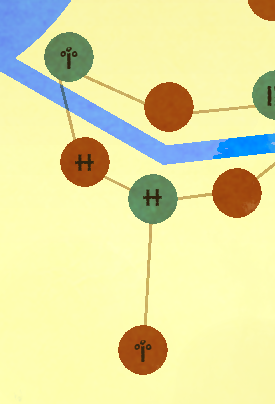
This Seshnegi map dates to the reign of King Lofting IV of Seshnela. It displays many hallmarks of Rokari map-making, being highly stylised with geometric curves and straight lines and the west being oriented towards the top of the map, pointing to the location of the primeval Land of Logic.
The map displays no political borders, nor geographical precision, making the map useless for exploration or martial endeavours. It was likely that this map was produced for a trading house.
While originally coloured with rich pigments, the lack of any writing suggests it was for use by illiterate merchants. Settlements are instead marked with small coloured circles, with particularly important cities being marked with a rune indicating a particularly important resource located there.

Also included on the map are four mountains. Three are marked with stasis runes, referring to the dwarven held Iron mountains to the south, and the Nidan mountains to the north. The last mountain is marked with the darkness rune, indicating it represents the Uzgor mountains, and specifically Vulture's Peak.
The western islands of Old Seshnela have been to three, likely the three great islands of Pasos: Varskolin, Volonne, and Culonmac.


The Southern Reaches

While covering many different provinces, this is one of the most compressed areas of the map, with the rivalry and occasional wars between Seshnela and the Quinpolic League being completely ignored. Likely, the author of the map rarely came to the southern reaches of Seshnela, leaving him to consult on earlier maps.
From left to right, top to bottom:

Amneleon - This town can be identified by the use of the plant rune, referring to Amneleon's control over Seshnela's Tea production.

Unknown - Likely Urfenoswal, due to its administrative role over southern Seshnela.

Hathwal - Primarily identified from its famous Floating Markets, indicated by the trade rune.

Noloswal - One of the greatest port towns in Genertela, Noloswal recieves little acknowledgement from this map, being notified only by a trade rune. This is part of what cement's this map's Seshnegi origins.

Unknown - Likely Rinalket, a border town between the Quinpolic League and the Kingdom of Seshnela.

Sreborket - The plant rune likely indicates either the sorcerous gardens devised by the city's wizards, or its role in harvesting lumber from Tarinwood.


The Iron Path

Quite possibly the most important trade route in Genertela, this path from Rhis to Relamorket involves a dangerous and exhausting trek through the forested highlands of Noyelle. Many merchants have been forced to turn back by beast-folk who dwell in the highlands, but many more still risk the journey, for the sake of purchasing iron.
From top to bottom:

Rhis - Part of the Castle Coast, Rhis is famous for being the only place where dwarves are willing to trade iron, indicated by this town's death rune.

Priina - The seat of power for the Count of Deu, this city was presumably little more than a resting place for this map's author.

Voi - The harmony rune refers to this city's ancient Xemelan temple and healing springs.

Relamorket - Located at the convergence of the Tanier and Deu rivers, Relamorket is a major crossroads in Seshnela.


The Heartland

This stretch of the upper Tanisor and southern Rindland has been expanded, presumably the result of the map's author's familiarity with this region increasing it's importance. This region is home to many rich wheat farms, compared to the lower reaches' rice paddies. 
From left to right:

Arnlor - This city is home to both the treasury and royal mint, making it the source of Silver Imperials found all over Seshnela and Safelster. The city is also home to many powerful guilds, making this a likely origin for the map's author, and explaining it being signified by the trade rune.

Vetagane - While unmarked, Vetagane is easily identified as the only major settlement between Arnlor and Segurane.

Segurane - Painted in faded gold and bearing the mastery rune, Segurane of the Walls is easy to identify. Within the outermost wall lies the great markets and homes of crafters and merchants, making this one of the greatest centres of trade in Seshnela.


The Safelstran March

The borderlands between Seshnela and Safelster are fraught with danger, over the rivalries between the kingdom and the city states, but also extremely valuable. Ironically, since the Opening, the direction of trade has shifted, since it is now far cheaper to ship goods overseas instead of passing along the Manirian Road.
From top to bottom:

Fornalor - This city is home to some of the greatest stables in the west. The horse breeders here are notoriously exacting, breeding and selling horses that bear the noble colours of black, white, and grey.

Leplain - Painted in azure and marked with the law rune, this is obviously Leplain, city of wizards, and home to the greatest libraries outside of the city of Sog. The markets outside of the Blue Temple are always full of rare goods, for the Ekozite School of Alchemy both needs and produces some of the strangest items in Glorantha.

Dangk - This city is located near to Hrelar Amali, the ancient ruins worshipped by barbarians as the city of the gods. Many pagans still make pilgrimages to the ruins, making Dangk's markets full of foreign, if crude, goods.

Heswal - The trade rune here is an interesting case, for Heswal is more infamously known for the toll placed on all goods going between Seshnela and Safelster. However, on the shores of the river before the island city, merchants have created a shanty market for trading goods, hoping to make extra profit before they need to pay the toll.

Kustria - The death rune marking this city refers to the Great Tournament held here each year. The need for new arms and weapons marks this city as an excellent place to trade oxhides of bronze for other goods.


The North

This region was once the heart of Arkat's Dark Empire, but ever since the empire fell, the land turned to wilderness. Although reclaimed by a succession of Seshnegi monarchs, much of the land is still unsuitable for wheat and rice, leading it to become the home of rye fields  and sheep pastures.
From left to right:

Ukos - The death rune helps signify this town, and refers to its swordsmiths, who are the best in all Seshnela, with their bronze blades being sought after even in far off lands.

Isarnos - While not marked with any rune of importance, Isarnos does have a market, where they trade in devices copied from dwarven plans by adventurous (and somewhat foolish) wizards.

Harsad - Harsad was built to guard over the ruins of Arkhome, and guard it from barbarian grave robbers and Arkati sorcerers. Despite the best efforts of the town's soldiers and wizards, there still exists a black market for Arkati goods within the town.

Xeinar - The southmost point on the Old Imperial Road between Seshnela and Fronela, Xeinar has never profited from this trade. This is because, due to the ancient rituals involved in taking the road, the inhabitants of this town never interact with those travelling between the two nations.


Far Tarins

This province of Loskalm being appearing on the map helps cement the dating of it to Lofting IV's reign, since it was only freed from the ban a mere eight years before his reign, and there would be little land trade between Seshnela and Tarins for years afterwards. This may in fact be the earliest Seshnegi map after the Ban and Opening to show the province.
From top to bottom:

Southpoint - The law rune helps identify this city as the home of the High Watcher of Hrestolism. Despite this, the author's Rokari bias can be seen by treating Southpoint as just another city, without the azure given to Leplain.

Isefwal - Once almost deserted, Isefwal grew into a thriving port once the Opening of the Oceans took place. It's role as the entryway for goods into Loskalm is noted by the trade rune.

Unknown - While likely Tarnwall, this may instead be Omphis, with no identifying symbols to hide that city's role in teaching Men-of-All, considered blasphemous by Rokari.

Midtasker - Although an important Tarins city, Midtasker receives little acknowledgement here, possible reasons include the author distrusting the ancient graves found here, it's importance to the old Middle Sea Empire of the second age, or a disagreement with a local merchant.

Svenlos - Svenlos is the northern edge of the Old Imperial Road, the only safe route through the dangerous Erontree forest. While surrounded by orchards, little of that is recorded here.


Special thanks to Kalin Kadiev for improving the appearance of the map.

Monday, 1 February 2016

New Pelorian

"When a nomad wants to talk of home, when a servant wants to talk of freedom, when a priest wants to talk of the world, or when a merchant wants to talk of gods; they use New Pelorian. It is a language which turns the unknown into the known, turns the strange into the familiar, and the foreign into the intimate. New Pelorian is the greatest gift of the Goddess, for it reveals that We Are All Us." - Poem by anonymous author.

Before the Goddess was reborn, there were three great languages found in Peloria:
  • In the centre was the ancient tongue of Dara Happa, inflexible and exacting, they claimed it was the original tongue of all people. To make the unchanging runes, the Buseri scribes used reed pens pressed into soft clay which was then baked; or carved with chisel and hammer into raw stone.
  • In the west was the strange sounding language brought by the Carmanians. They claimed it was the original tongue of all people. The glyphs used by the Carmanian wizards were painted on papyrus scrolls, made from the reeds around Lake Oronin.
  • In the south came the barbaric Therelmic tongue, which was used in Sylila and the other storm worshipping lands. They claimed it was the original tongue of all people. The ancient symbols were inscribed into wood, and scratched into the hides of animals by the Greybeard sages.
The Goddess saw this, and knew that each language was wrong, but also right. They could not all be the original tongue of all people, but they each contained seed from it. Each had a written form, but they were hidden away by knowledge hoarding cults.

The Goddess sent her daughter, the Great Sister Deneskerva, to find the truth hidden within the languages, so that her message could be spread to one and all, sage and savage. Deneskerva went abroad the fledgling Empire to speak and listen to all those who would talk with her. She heard their words, and found the right ones within them, the words that would be the True Language of the Goddess. When she had them, she went to a scribe to build that tongue. Together, she and the scribe also shaped the Dara Happan runic script into something that could be written on papyrus.

The result, New Pelorian, was a language unlike any other in Glorantha. Its words came from languages all across Peloria, but healed and repaired, so that they were as one. Although one word may come from Carmanian, and another from Dara Happan, through the miracle of the Great Sister, they could be used and understood together, as if they were always meant to be.

The Great Sister spoke to the missionaries of the Red Goddess, instructing them in this new language, which they shared with the people they went to enlighten. Its perfection made it easy to learn, and soon the foreigners could understand the missionaries perfectly. The missionaries were also able to carry sacred texts with them, for papyrus was much lighter than clay tablets.

Within the Empire, the script and words were shared with the scribes of Irippi Ontor, who were not afraid of change like other scribes. They used it to translate the ancient texts into new scrolls that could be read by anyone. They taught it to workers, to priests, and to nobles. Even when their own language was sufficient amongst their own people, New Pelorian was used to speak to foreigners, to record information, and to read the words usually kept hidden by the old priests.


The symbols of New Pelorian
New Pelorian's script was derived from the ancient Dara Happan Sacred Alphabet, but altered to make it easier to learn, read, and write. Allowing literacy to spread like wildfire.


Z        Little changed from the original Dara Happan rune, being only altered to use a pair of strokes.

T        This glyph has not fundamentally changed from the Sacred Alphabet.
U        The bottom part of this glyph has been left off, while the rest has been rounded into a simple loop.

R        This glyph has not fundamentally changed from the Sacred Alphabet.
L/Y        The ancient runes L and Y were simple dots within a square and triangle. New Pelorian has merged the two symbols, if not the sounds themselves (usually), by replacing the containers with the celestial circle.
Th        This glyph has been rounded, and the two sides have been fused at the top for less strokes to be required.
F        Once a diamond with a small line within, the line has been lengthened, and the diamond rounded into a glyph resembling the Moon Rune.
P        The bottom side branches of  this glyph has been left off, while the rest has been rounded into a simple loop.
I        The crossbars have formed a loop to the right of the glyph.
E/V   This glyph still resembles the Dara Happan rune for E, even though it has absorbed the rune for V. This has resulted in a "paddy field" effect for some names, like Everina, the goddess of rice.
M       This glyph has not fundamentally changed from the Sacred Alphabet.
S        The lower half of this glyph has been rounded.
O       The left and right extremes of this glyph have become more flamboyant, but otherwise it has changed little.
A       This glyph combines both the old A rune of the alphabet, with the feminine suffix which made the same sound, while simplifying both.
H       Like many others, this rune has been rounded, especially at the bottom.
G       This glyph has changed little, with only the characteristic rounding having taken place.
N       This glyph has not fundamentally changed from the Sacred Alphabet.
D       Like the glyph for L, the old Dara Happan D rune has been rounded, turning a oblong into a circle.
Sh      This glyph has changed little, with only the characteristic rounding having taken place.
J         The top crossbar has merged with the upper limbs of this glyph, which have themselves been curved, making it resemble a staff with an inverted stasis rune atop it.
Qu      The wings of the ancient rune have become a continuous loop, with the dark core being replaced by light.
W       While the crossbar has remained unchanged, the diagonals have become curves.
B        The lower strokes of the ancient rune have gone, taking it to a simple glyph.
K        The diagonal stroke to the top right has been eliminated from the ancient rune, and its form exaggerated into the modern glyph.

Monday, 11 January 2016

Moonstones


Inspired by discussion on the Glorantha Google+ page here

Gold and Carnelian broach depicting the Red Goddess.
The term Moonstone is used within Glorantha to refer to a wide variety of objects. From the nearly mundane pieces of sard and onyx used as jewellery by the lesser nobility of Peloria, to the myriad charms used by the unkindled lunar worshippers, the term can refer to almost any stone; although usually only those of red, black, white, and blue are considered truly sacred.
However, these moonstones are pale reflections of true Moonstones, just as spirits and spells are pale reflections of the true magic of the Red Goddess.
True Moonstones are said to have come from the Red Moon itself, and can take nearly any form or substance; making it easier to understand how the lesser or false moonstones could be mistaken for the real thing.

What sets them apart is their power. Each Moonstone seems to glow with the light of the Red Goddess in one of her seven phases, even those associated with the dying or black moons shine a contradictory bright shadow. Lunars who have kindled their Moon Rune find this spiritual radiance calming, and those who have been crazed by Occlusion can find their madness quieted when in its presence. The Orlanthi claim to find the glow of a Moonstone irritating, and attribute this to the Moon's Chaotic nature. At least one instance of kinstrife has been blamed on poisoning by powdered Moonstone.

The effects of Moonstones have been well attested, if not well understood:
  • The Moonstone may be used to summon a Lune, much as a shade can be summoned from a pool of darkness, or a campfire can be used to give birth to a salamander. The stone will typically crumble after use, or at least be lessened by the summoning.
  • The Moonstone can be used to to craft a Glamour as if the Moon was full. The Moonstone can only be used a few times for this purpose before it crumbles to dust.
  • Even those whose Moon Runes are not kindled can use a Moonstone to create an Evocation based upon the phase of the Moon the Moonstone is associated with. The Moonstone is always consumed by this. Regardless of the phase of the moon, this is always a stretch.


Natural Moonstone prism.
What only the most Illuminated understand about the Moonstones, is that they are not truly real.

Each Moonstone is a fragment of the Red Moon's power, substantiated in Glorantha. They are solidified Lunar magic, a Glamour made manifest. As such, they can be unwoven from their material shape, and used to shape Glamours. When used to summon a Lune, the Moonstone is instead rewoven into the form of a Lune, and some say that Lunes can be turned into Moonstones in turn.

Because Moonstones are a form of Glamour, Moonstones can be created by powerful magicians, such as the Crater Makers.  The making of Moonstones is an exhaustive process, and even then the Moonstone is lesser than those created by the Goddess and her attendants, and will fade eventually.


This of course, leads to a further revelation. As Moonstones are made from the same substance as the Red Moon, and as Moonstones are a form of Glamour; the Red Moon itself is a Great Glamour, woven by the Red Goddess to be her footstool when she ascended. This is why it waxes and wanes with the Lunar cycle, not as its cause, but as its symptom. The Goddess Rufelza, seen as the material aspect of the Red Goddess, can also be seen as the Lune manifested as the Red Moon.


Blue Moonstones
Blue Moonstones, also known as Dead Moonstones are superficially similar to normal Moonstones. They give off a spiritual light and are connected to the ancient Blue Moon of the gods age. Despite the name, Blue Moonstones are rarely blue, instead being a dull grey. It is only when viewed with magical senses, that the deep blue light they give off becomes visible.

Unlike regular Moonstones, Blue Moonstones cannot be used to create Evocations, nor can they aid the creation of other forms of Glamour.
Instead of a Lune, a Blue Moonstone may be used to summon a Selene, also known as a Dead Elemental. These spirits are invisible to normal vision, but are all too real when they engulf their victim. Those unfortunate enough to be swallowed by a Selene slowly has their soul unravelled. Their fire goes out, their breath becomes shallow, their body becomes withered and frail.
They can only take form from the invisible light of a Blue Moonstone, making them thankfully rare.

Wednesday, 24 June 2015

Jack O'Bears

Chen Durelite Vessel in the form of a Jack O'Bear
History
Jack O'Bears first appeared in the Great Darkness, when many chaotic horrors roamed the land. Unlike many of these horrors, no single source has ever been found for the Jack O'Bears. Instead, they seem to have just emerged fully formed from the primal wellspring. Despite this, many peoples have come up with their own explanations of how the Jack O'Bear came to be.
The troll lovers of the Kingdom of Ignorance say that when the dark god Tien came to attack them in the darkness, their masters slew and devoured each and every one of Tien's soldiers. Alone and without any protectors, Tien stumbled into a bear-den while attempting to hide from his pursuers. Surprising the bears as they hibernated, he cut off their heads and bound their souls to him, and then raised their bodies as horrific monsters. To replace their heads he had them place a pumpkin atop their neck, and carved a fearsome face into its surface. He then set them loose to plague the world, while he fled back into the wastes.
In the west, it is popularly said that Jack O'Bears are the spawn of a hellish plant, created by the Devil to feed his army. The Jack O'Bears were its seeds, sent out to gather refuse and waste to feed this monstrous thing. The leader of the Black Horse Troop, Sir Ethilrist, claims he met this beast in his travels, and cut his way out when it swallowed him whole. Certainly his description of this devouring monster as a giant pumpkin would suggest a connection, but despite common folklore, the Jack O'Bear an animal, not a plant or hybrid of the two.


Appearance
Jack O'Bears (Joannursus paralysis) resemble the brown or grizzly bear of western Genertela, at least for the most part. The Jrusteli Naturalist Ocran Everseer believed they represented an offshoot of brown bears, although so far altered by the touch of Chaos that they can no longer breed with any other bear. Certainly they share much of their range with the brown bear, the majority of Jack O'Bears being found in a band from Fronela, through Ralios, to Maniria. Despite this, a subspecies (Joannursus paralysis ignoramus) has been found in the Kingdom of Ignorance, north of Kralorela. Whether these are native, or the result of some chaos cultists spreading them deliberately, is unknown.
The most striking characteristic of a Jack O'Bear is its head, which is completely hairless, lacks external ears or lips, and only has a thin pair of nostrils. Instead of fur, the head is covered with a layer of leathery skin, beneath which runs a network of blood vessels, which gives the head a blood red appearance in infant bears, before paling to a vibrant orange colour when the skin thickens at maturity.
With older Jack O'Bears, the skin has instead been likened to that of a pumpkin or other gourd, giving rise to legends that the beast is part plant.


Habits
Found only in the most isolated and desolate of places, Jack O'Bears are solitary beasts, who view even their own kind as enemies and rivals. Only the Jack O'Bears of the Kingdom of Ignorance have been known to ever socialize, congregating along the great coast of Koromondol in great numbers. Magical observation has shown the beasts swaying from side to side and making a great sussuration, which has been referred to as "singing." The purpose of this act is unknown, but knowing their chaotic nature, it can be assumed to be a grave danger to Glorantha.
Elsewhere, Jack O'Bears can occasionally be found in chaos nests, where Broo, Ogres, or other horrors feed them with parts of their victims. It is likely that the Jack O'Bear merely tolerates their presence because of this tribute, while the chaotics feel this is a small price to pay for the protection the Jack O'Bear provides, for while they may ignore their chaotic "guests", they will attack all others who intrude, acting as guardian and protector for the chaos nest.


Magic
Although possessing of a certain diabolical cunning, the Jack O'Bear is rarely intelligent enough to worship the Lords of Terror, and so only the most extraordinary individuals have learned magic. This can be seen as a blessing, for they already possess an insidious Chaotic power, to freeze and stupefy their victims, making them unable to resist the Jack O'Bear's attacks. Although commonly held to be the result of meeting the creature's gaze, the Jack O'Bear in fact needs only to think about a nearby person for them to fall victim to their insidious gift.

Tuesday, 19 May 2015

Sprites

Pelandan painting of a sprite
History
It is unknown exactly when sprites first appeared in Glorantha. Conventional wisdom claims they were creatures of the Green Age, like the vast majority of Aldryami. However, sprites are intricately connected with flowering plants, which were proven by the God Learners of Jrustela to first appear in the Golden Age.
Even their origin has been called into question, some of the myriad of stories include:
  • In Dara Happa it is said that the god Arraz (sometimes called by the elven name Shanassee) created the first sprites in imitation of the winged Certami, to please the goddess Erenbaya mother of plants.
  • In Ralios, sprites are said to be the flowers born by Flamal the great tree, which fell to the ground in mourning when he was destroyed by Zorak Zoran.
  • The Orlanthi say that the sprites were created by the elves in imitation of Orlanth's Impests, the spirits which fly to vex those who have offended the King of the Gods. Like these petty gods, sprites are sent to plague those who have offended, and the Heortlings are known to call them Imps, after the messengers of Orlanth's wrath.
All of these myths, and others have enough evidence supporting them; but the Dara Happan legend has spread wide enough that it is accepted in many lands as the truth, even when Arraz is unknown to them.
What is known is that the sprites were present when Flamal fell at the hands of the trollish war god, and all died on the spot, or were sent into the underworld by his servants.
The sprites themselves, on those rare occasions when one has been interrogated, claim that they saw the thralls of Zorak Zoran, the burrowing rodents. These beasts chewed through the roots of the Great Tree, rendering him vulnerable to Death. They dove into the underworld to pursue the rodents, and have been fighting a war against them ever since, even after they reappeared on the surface at the dawn.


Appearance
God Learner Woodcut of a sprite bound by a dog spirit
It is very hard to get a decent look at a sprite, due to their caution and small size. Their appearance is further
clouded by the motes of some luminous substance, the infamous pixie-dust desired by alchemists and poisoners. Most who have seen them describe them simply as tiny humanoid figures with brightly patterned wings.
When examined closely, any idea of them being child-like or beautiful quickly falls away. Sprites, like other Aldryami, more closely resemble plants than humans. Their body is formed around a large central root acting much as the torso does with other creatures, while other more slender and flexible roots sprout off from it, acting as arms and legs, with no great distinction between one or another.
These limbs rarely display any form of symmetry, with odd numbers of finger-like rootlets sprouting from their limbs almost at random, which they use to grasp objects.
The "head" of the sprite sprouts above the central root, formed out of a flower-like organ, the result resembles the antenna of a timinit, with stamen-like organs providing sight, sound, and other senses to the sprite, all concealed by protective petals when not being used.
The wings of a sprite are formed from what, on a normal plant, would be leaves. The network of veins across them giving a superficial resemblance to those of butterflies or moths, as does the ever-present dust which coats them.
This radiant dust is shed in vast amounts by a sprite when confronted with humans and other non-Aldryami, and seems to be its pollen. Exactly why this is done has been debated amongst scholars. The two most dominant theories are as follows: Firstly, that it is done to ensure survival of the species, to lay the seed of the next generation even when the current generation of sprites is endangered. The other is that the pollen acts as a kind of language mankind is not privy to, and is much like how an animal roars to scare off a predator.


Habits
Sprites have the shortest lifespan of any Aldryami, living for just a single year at most. While the vast majority are born in Sea Season and die in Storm Season, there are some forms, kin to winter flowering plants, who are active in the Dark and Storm seasons.
Sprites spend most of their short life in a dormant state, buried just beneath the surface, with only their head and wings exposed. In this state, they resemble just another flower or weed, and on occasion an unwary traveller has camped in a field to rest, only to discover he is in a nest of sprites. The reason for their dormancy is unknown, with God Learner studies determining that your average sprite spends less than a season active.
When active, sprites spend much of their time guarding flowers in isolated groves, or spying on intruders into elven forests. They will often serve as spies for the larger elves, watching invading humans or trolls from high branches out of sight, or even from the spirit world.
When forced into violence, sprites will typically flee, for they are flimsy beings, and at great danger from enemies. They will take advantage of their ability to fly, and when enemies cannot reach them, will often pelt them with small stones or nuts. This poses little risk, but can distract enemies to allow elves or other Aldryami to flank them.
The one exception to a sprite's caution, is against rodents of all kind, which the sprites blame for the death of Flamal. They will attack rats, shrews, and even rubble runners with a fury unseen outside of berserkers. Occasionally a visitor to an elven wood may even find rodents impaled on thorns, like the victims of a butcher bird.


Magic
Sprites are beings that stand on the boundary between the inner world, and the spirit world, and are able to see and interact with spirits as if they were solid entities. Sprites may even become spirits themselves through concentration, abandoning their material form, and appearing to vanish into thin air.
In this state, sprites are vulnerable only to spirits and shamans, but likewise cannot attack those in the inner, material world.
Sprites are loath to remain as spirits for long, suggesting that it is uncomfortable, or even painful to them.
Other than this, sprites have no other innate magic. However, like other Aldryami all sprites are part of the Aldrya tradition, although none has ever become a great magician or shaman.